Link-in-Bio vs. a Full Website — Which Do You Need?
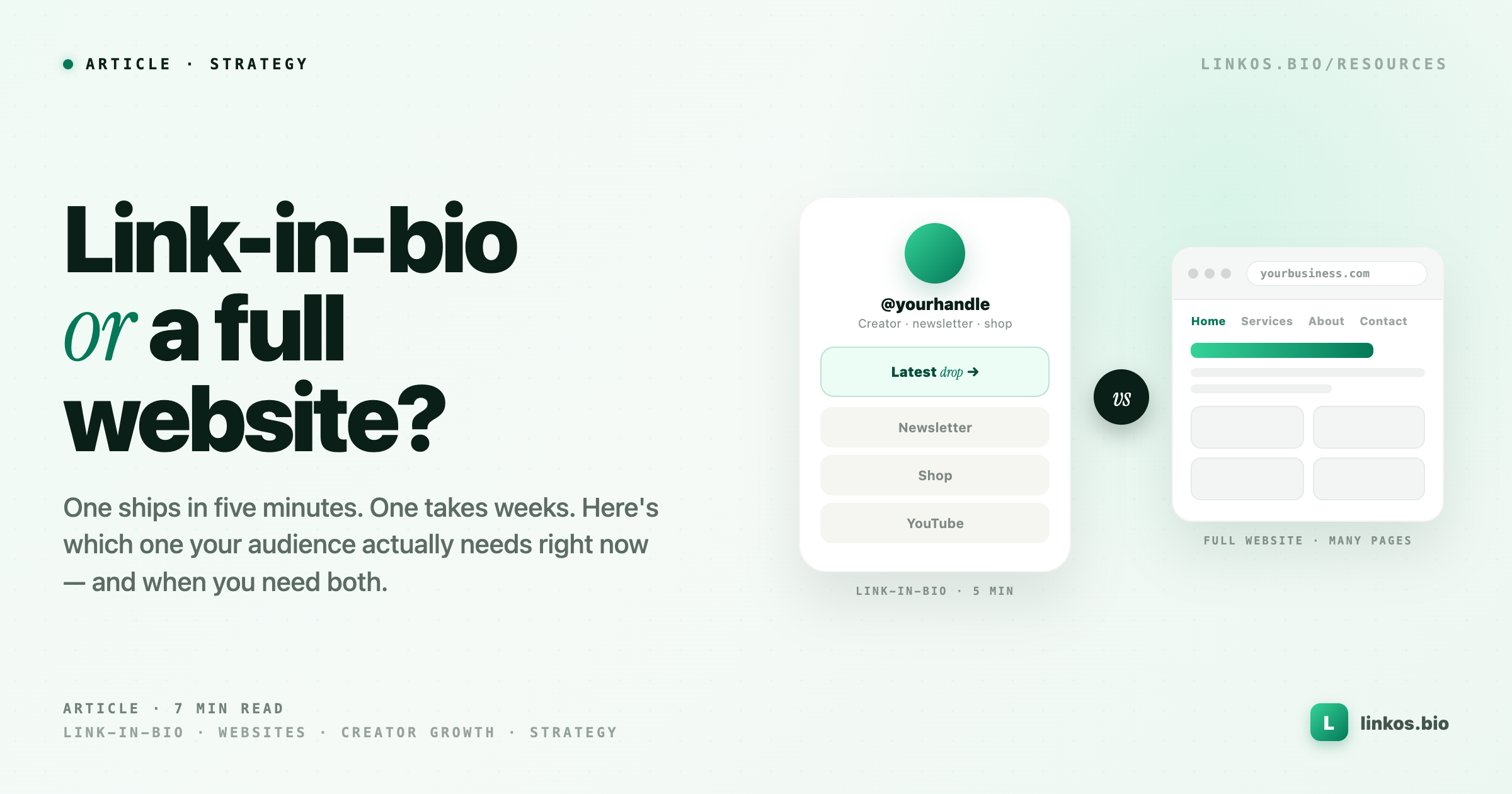
A link-in-bio ships in five minutes; a full website takes weeks. Here's how to tell which one your audience actually needs right now — and when you need both.
Key takeaways2 min · read this first
- A link-in-bio wins on speed, mobile, and how often you change links; a full website wins on depth, many pages, and owned search real estate.
- Most people need a bio page first and a website later — not both on day one.
- Choose by your bottleneck — if the problem is "people can't find my stuff," start with a bio page; if it's "I have a lot to say or sell," build the site.
"Do I need a website?" is one of the most common questions creators and small-business owners ask — and it's almost always the wrong question.
The real question hiding underneath is: how do people find my stuff online, and what do they do when they get there? Sometimes the answer is a full website. Very often, especially at the start, it's a link-in-bio page. They're not competitors — they solve different problems — and knowing which one you need right now saves you weeks of building the wrong thing.
Here's how to tell them apart, and how to choose.
What each one actually is
A link-in-bio page is a single, mobile-first page that lives behind the one link social platforms give you. Instagram, TikTok, and YouTube only let you put one clickable URL in your profile, so that link has to do a lot of work: point people to your latest video, your shop, your newsletter, your booking form. A link-in-bio page is that hub. It ships in minutes, it's built to be tapped on a phone, and you change it constantly — new drop, new link, done.
A full website is many pages: a home page, an about page, service or product pages, maybe a blog, a contact form, a booking system. It's where depth lives. It takes longer to build, it's meant to be found by search engines as well as by people, and you change it far less often.
The mistake is treating them as either/or. They answer different questions:
- A link-in-bio answers "where do I send my followers?"
- A website answers "how does a stranger who's never heard of me understand and trust my whole business?"
When a link-in-bio is enough
Start here if most of these are true:
- Your traffic is social and mobile. Your audience finds you on Instagram, TikTok, or YouTube and taps through on a phone. A bio page is built for exactly that moment.
- Your links change often. New video weekly, new product drop, a link that's hot this month and gone the next. Editing a bio page takes seconds; editing a website is a chore you'll avoid.
- You're one person, or a small brand. You don't have a catalog of a hundred pages — you have a handful of things you want people to do.
- Speed matters more than depth. You need to be live today, not after a three-week build.
This is the sweet spot for a tool like Linkos. You build your page in about five minutes, point every profile at it, and update it whenever your content changes. You get a clean, fast, mobile-first page, real analytics on what people actually tap, brand templates so it looks like you and not a template, and a custom domain when you're ready — free to start, forever. For most creators, that covers the whole job for a long time.
When you actually need a full website
A bio page stops being enough when your problem shifts from "where do I send people" to "I have a lot to explain, sell, or rank for." Signs you've crossed that line:
- You have real depth to publish — long guides, a proper blog, a portfolio, case studies, documentation.
- You sell more than a few things — a product catalog, categories, filtering, a real cart.
- You need to be found in search, not just shared on social. If customers find you by Googling "electrician near me" or "wedding photographer Austin," you need pages a search engine can crawl and rank — a bio page alone won't carry that.
- You're a local service business. Contractors, cleaners, clinics, pet pros, tradespeople — your customers expect a website with your services, service area, hours, and reviews before they'll call.
That last group is worth calling out, because building a full website used to mean an agency and a five-figure quote. It doesn't anymore. If you're a local or service business that needs a real site — many pages, its own domain, built to be found on Google — a tool like Tocayo will build one for you from a few questions and let you edit it by typing, no agency required. Different job, different tool: Linkos is the mobile front door for creators; a website builder like that is for businesses that need the whole house behind it.
The honest answer: most people need both, in order
Here's what nobody selling you either product wants to admit: for a lot of people the answer isn't "pick one" — it's "start with one, add the other later."
A creator almost always starts with a bio page (that's where the traffic is) and may never need more. A local business almost always needs a website (that's where trust and search live) but still benefits from a bio page for its Instagram. When you have both, they work together: the website is the deep, ownable home base, and the bio page is the fast, swappable hub you point social traffic at — and you just link the two.
The wrong move is building the heavy thing first because you feel like you "should have a website," then never updating it. Build for the job in front of you.
A 4-question decision test
Answer these honestly:
- Where does your traffic come from? Mostly social and mobile → bio page. Mostly search, referrals, or word-of-mouth that ends in a Google search → website.
- How often do your links change? Weekly → bio page. Rarely → website (or both).
- How much do you need to say? A handful of destinations → bio page. Many pages of services, products, or content → website.
- What's your actual bottleneck? "People can't find where to click" → bio page. "People find me but don't understand or trust the business" → website.
If you're stuck, ship the bio page first. It takes five minutes, it's free, and it tells you — through its analytics — what people actually want, which is the best possible brief for a website later.
FAQ
Do I need both a link-in-bio and a website?
Not on day one. Start with whichever solves your current bottleneck. Creators usually start with a bio page; local and service businesses usually need a website. Many people end up with both, linked together — but that's a "later" decision, not a "first" one.
Can a link-in-bio replace a website?
For a lot of creators, yes — for a long time. If your job is "send my followers to the right place," a bio page does it. It replaces a website when you don't have deep content or a catalog to host and you're not relying on Google to find you.
Will a link-in-bio help me rank on Google?
It gives you one clean, linkable page — helpful, but it's not a substitute for a multi-page site if search is how customers find you. If ranking for things like "service near me" matters, that's a website job.
I'm a local business — where do I start?
With a website, because customers expect one before they call, and because search is where they find you. Then add a bio page for your social profiles. You can get a proper site built without an agency these days, which removes the old excuse of "it's too expensive."
What's the fastest way to just get something live today?
A link-in-bio page. You can build one in about five minutes on Linkos, free, and point every social profile at it this afternoon.
Sign up to start earning XP for every read.