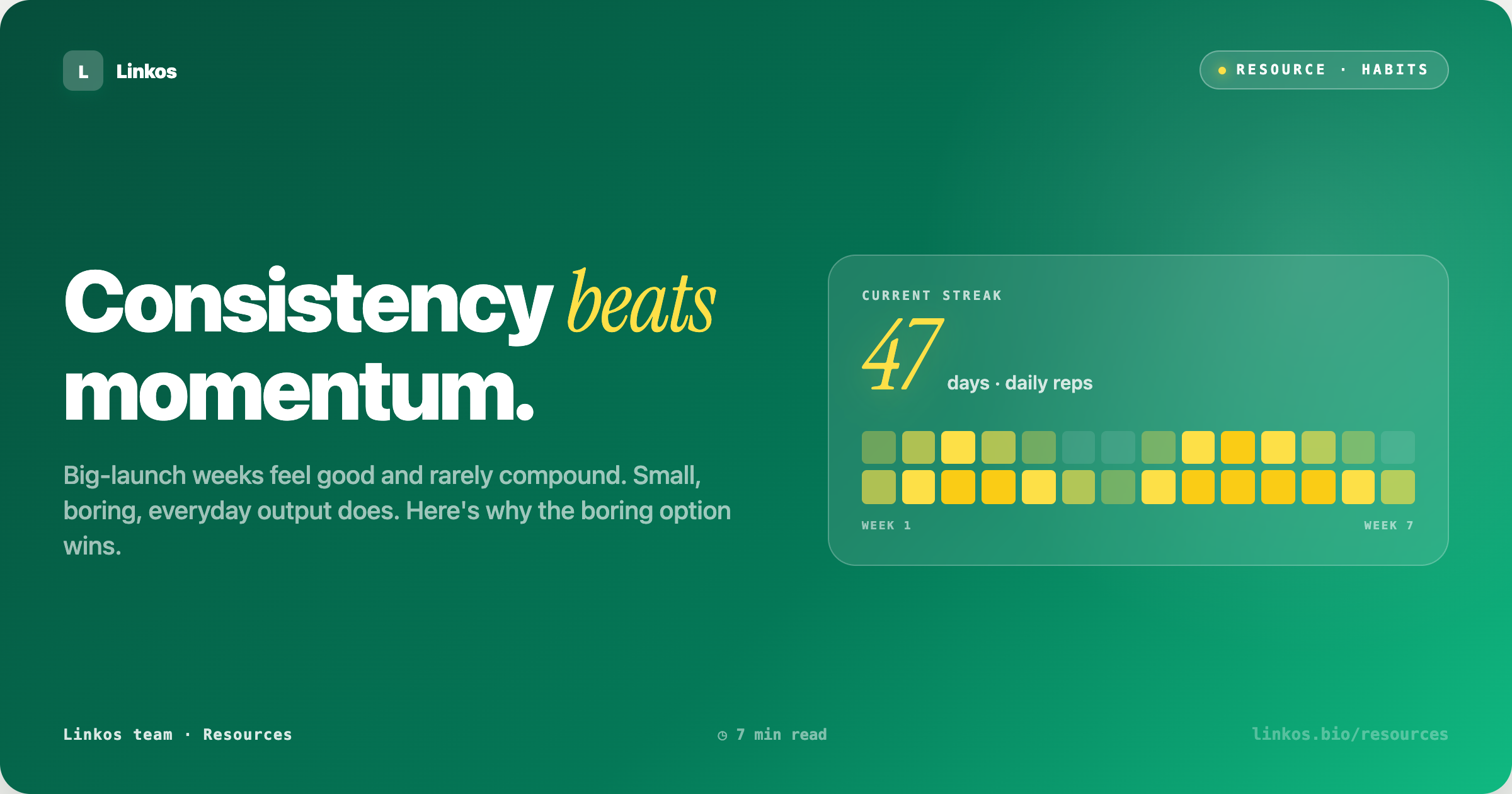
Consistency beats momentum — every time
Big-launch weeks feel good and rarely compound. Small, boring, everyday output does — because the daily creator on day 47 has already lapped the burst creator on their third comeback. Here's why momentum breaks, why the habit is the trigger not the output, and the streak system that keeps you shipping.
Key takeaways2 min · read this first
- Momentum is the feeling of doing a lot at once. Consistency is doing the small thing every day. Only one compounds.
- After 12 months, consistent creators outproduce sporadic ones by roughly 4x — not because they work harder per day, but because they never fall off.
- The habit is not the output. The habit is the trigger. Same time, same place, same first move — output follows.
- Small daily units beat large weekly ones. 15 minutes daily beats 3 hours on Sundays because 15 minutes never gets skipped.
- Streaks are motivation infrastructure. They convert intention into a system you would have to actively choose to break.
A creator who ships a small thing every day for 12 months will out-produce a creator who has three explosive weeks per year. This is not a motivational claim — it's arithmetic. 365 things beats 21 things. What makes the arithmetic work is the boring truth that the daily creator never gets to zero, and the burst creator does, and getting back from zero is where most careers end.
We tell ourselves stories about momentum because momentum feels like the thing. A great week, a viral post, a launch that lands. The feeling is real. The pattern isn't durable.
Momentum is a mood. Consistency is a system.
The 12-month math
Two creators start on the same day. One ships something small every day. The other saves it up, has explosive weeks, then rests. Here's how the year plays out:
| Month | Burst creator | Consistent creator |
|---|---|---|
| 1 | 8 things (one big week) | 30 things |
| 3 | 22 things total | 90 things total |
| 6 | 40 things | 180 things |
| 9 | 55 things (one skip month) | 270 things |
| 12 | ~70 things | ~365 things |
By month 4 the consistent creator has already lapped them. By month 8 the gap is uncomfortable. By month 12 they're on different curves — and each of those small daily reps is compounding on the last (practice, distribution, list growth, audience trust).
Why the burst pattern breaks
Every burst is followed by a slump. The physiological reason is easy — you've spent your creative reserves, your body wants rest. The psychological reason is harder:
After a big week, the next thing has to be as good as the big week, or it feels like a step back. So you delay. You wait for the next inspiration wave. Waves get further apart.
Meanwhile the consistent creator is on day 47 of small things. Nothing they've shipped is as loud as your best week. Every one of them is a rep. Every rep compounds.
The habit is not the output
The most common mistake creators make when trying to be consistent is defining the habit as the output.
| Output goal (fragile) | Trigger habit (durable) |
|---|---|
| "I'm going to post daily" | "At 7am I sit at my desk and open drafts" |
| "I'm going to write 500 words" | "After my second coffee I open the doc" |
| "I'll ship a video every week" | "Sunday morning I open the editor, no goal" |
Output goals fail because output depends on 20 things — mood, energy, ideas, feedback, algorithm. Any of them goes wrong and the goal breaks. When the goal breaks, the streak breaks, and now you're negotiating whether to restart tomorrow.
The habit is the trigger, not the output. What comes out of the trigger — 500 words, 50 words, a two-sentence outline — is a separate question. The trigger is what compounds because the trigger is what you actually control.
Small units beat big ones
15 minutes daily beats 3 hours on Sundays. The math looks similar (105 vs 180 minutes/week), but the math is wrong:
| Unit | Weekly minutes | Realistic skip rate | Actual weekly output |
|---|---|---|---|
| 15 min daily | 105 | ~5% | ~100 min |
| 30 min daily | 210 | ~10% | ~189 min |
| 1 hr, 3× week | 180 | ~25% | ~135 min |
| 3 hr, once weekly | 180 | ~30% | ~126 min |
15 minutes daily never gets skipped because the argument you make with yourself is not "should I do this today" but "can I really not spare 15 minutes." Nobody wins that argument against themselves.
3 hours on Sunday gets skipped roughly a third of the time because 3 hours is negotiable. Life fits into 3 hours. Life doesn't fit into 15 minutes.
Streaks are infrastructure
Every creator who has run a streak for 30+ days will tell you something similar:
At some point the streak stopped being about wanting to. It became about not wanting to break something I'd built.
That's the mechanic. Streaks convert desire into structure. Structure is what gets you to day 200 when desire is not there.
That's also why streak systems have freezes. You don't want to punish someone for one bad day — you want to keep the structure intact. One missed day inside a 90-day streak is not a failure. Zero freezes and two missed days is a full reset. Full resets are where careers end.
A day in each life
Burst creator, day 47:
"I'll work on the big video this weekend. I have too much on this week — no point starting something I can't finish. Waiting for a proper block of time."
Consistent creator, day 47:
"Opened the draft. Wrote three sentences. Closed it. Same time tomorrow."
By day 200, one of them has a body of work and the muscle to make more. The other has a to-do list.
Common objections
"But viral moments matter — one big hit can change everything." They can. The problem isn't that big hits are bad; it's that you can't schedule them. Consistency puts you in more chances at the viral moment because you have more surface area. Betting on the big moment as a strategy is betting on lottery tickets.
"I need inspiration to write." Inspiration shows up more often for people who show up more often. The trigger creates the inspiration, not the other way around. Ask any writer who's kept a daily practice for a year.
"My format needs longer work sessions." Some do. Video edits, music production, long-form essays. The habit for those is still a daily trigger — you don't have to finish a video every day, but you should open the project every day. Fifteen minutes of "just look at where I left off" keeps the momentum from dying between sessions.
Pop quiz · 5 questions · ~60 seconds
Consistency check
Answer 5 multiple-choice questions. See your tier at the end. Bragging rights optional.
FAQ
How long before consistency shows results? Meaningful visible results, ~3 months. Meaningful audience results, ~6-12. But the reason to start is the compounding, not the timeline — the practice at month 3 is the reason the growth at month 9 happens.
What if I break my streak? Restart the same day. Not tomorrow. The gap between the miss and the restart is the whole risk zone; the longer it opens, the harder the restart. If your system has freezes, use one.
Should the habit be at the same time every day? Yes, if you can. Time-anchored triggers stick harder than "whenever I get to it" triggers. If your schedule genuinely varies, anchor to an event instead (after morning coffee, after school drop-off, on the train).
Does this apply to visual creators — photographers, illustrators? Yes. The trigger for a visual creator is "I open the camera / sketchbook," not "I make a finished piece." Fifteen minutes of open sketchbook counts.
What's the minimum viable daily unit? Whatever unit you can honestly commit to on your worst day. For most people that's 10-15 minutes. It's better to over-perform on a small commitment than to break a big one.
The one job
Your job as a creator is to build one durable habit trigger and protect it. The output takes care of itself.
Sign up to start earning XP for every read.
📗 Free: the Link-in-Bio Starter Kit
The checklist, 6 layout templates, and our 1-page cheat sheet — sent straight to your inbox.
Recommended tool
Turn each topic into a finished post — in seconds.
PostPop writes the copy and designs the carousel in your real colours, fonts and logo. The making step, gone.
- On your brand, automatically
- Six formats · every platform size
- Free to start · no credit card
◆ A product by Linkos