How we made the Mochi Classic sticker pack
Mochi left the app: twelve sticker poses chosen from artwork we already owned, a die-cut border that vanished on white paper, a four-pack launch we cut down to one, and a one-time price instead of a subscription. The full making-of — including the decisions we reversed along the way.
Key takeaways2 min · read this first
- The twelve poses weren't commissioned — they were chosen from the app's own artwork. Inventory what your product already owns before paying for new assets.
- The die-cut white border does two jobs: cutting margin on paper, separation in chats. White-on-white made it invisible on the print sheet — hence the faint gray guide line.
- We killed the four-pack launch for a one-pack pilot: the shop code is identical either way, only the artwork scales with pack count. Let demand pay for pack two.
- €4 once, no subscription — a finished set of files has no ongoing cost, so recurring billing would be rent on a JPEG. Sloth+ members pay €3.
- Owners keep everything permanently — downloads and both exclusive skins survive even if the pack stops selling.
- Product three isn't our call: the "you decide" slot in the marketplace is filled by whatever Sloths say they'd actually buy.
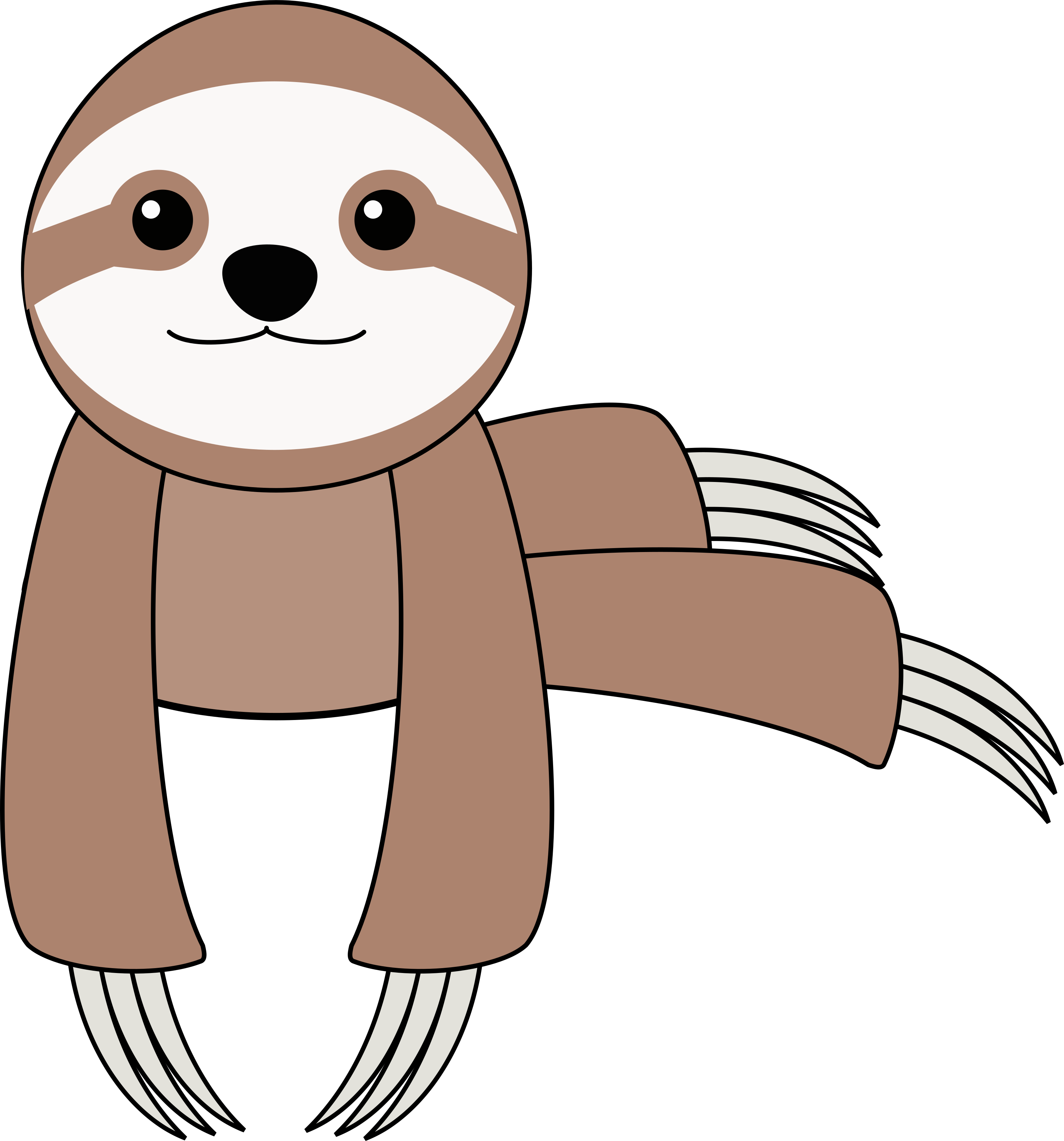
If you use Sloth Mode, you've met Mochi — the sloth that waves at you from the dashboard, celebrates your level-ups, and guards your streak. The Classic sticker pack is that same character, pulled out of the app and made ownable: twelve stickers, a printable sheet, two exclusive skins, one payment.
This is the story of how it got made, including the decisions we reversed. We're writing it down partly because making-of posts are fun, and partly because the decisions are reusable if you're building a small digital product of your own.
The poses came from the app, not a brief
The first plan was the obvious one: hire an illustrator, write a brief, wait, review, pay. We budgeted for it. Then we noticed something better sitting in the codebase.
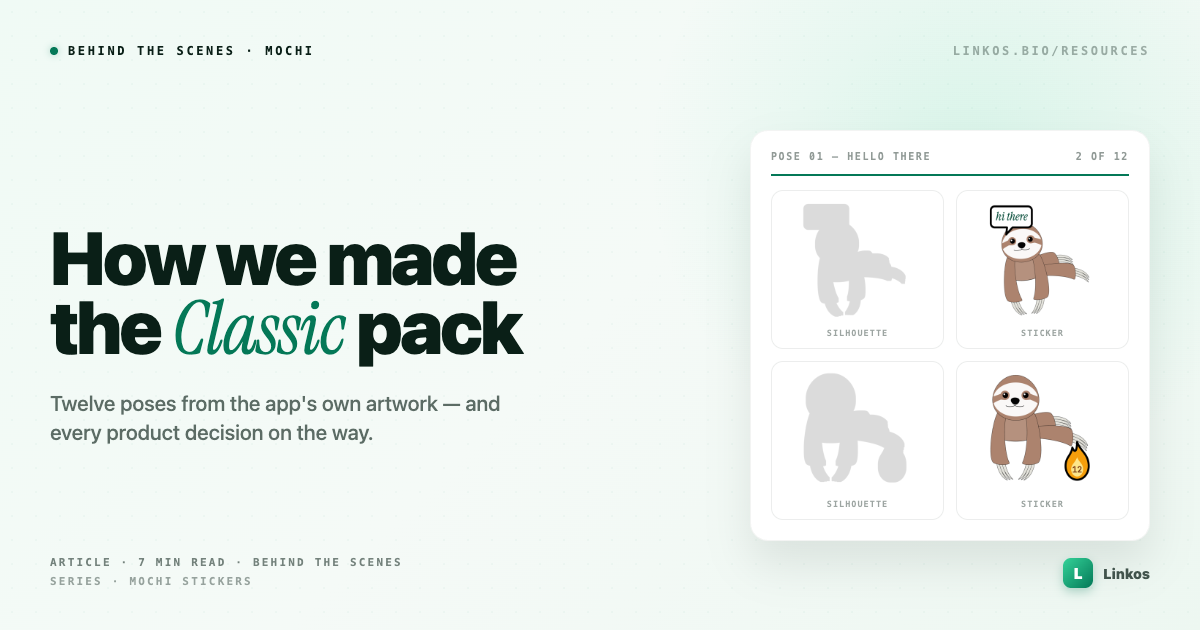
Mochi already exists as vector artwork — the same file that renders in the app at every size from a 48-pixel icon to a full hero. And the app already had a pose vocabulary: Mochi waves, climbs, peeks, shrugs, naps, celebrates. Those animations are the moments users actually see, which meant the sticker poses didn't need to be invented. They needed to be chosen.
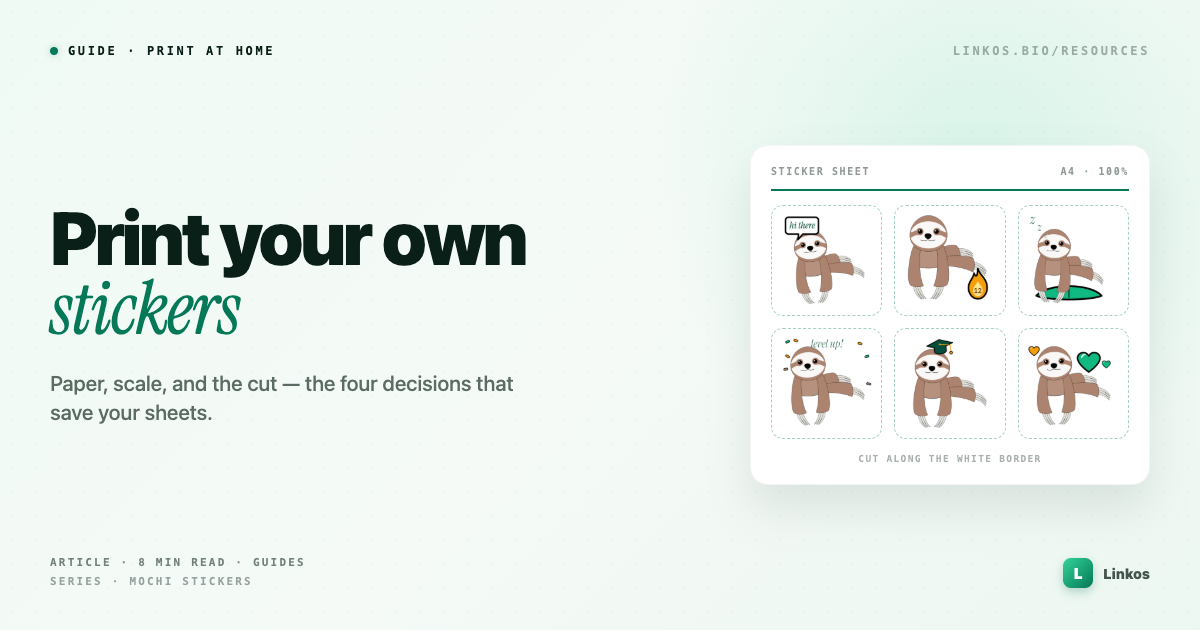
So the twelve stickers are twelve moments from the product: the wave you get on the dashboard, the streak flame from your streak page, the graduation cap from Academy certificates, nap mode, coffee first, the level-up confetti. If you use Sloth Mode, you already know every one of them. That recognition is the entire point — a sticker of a character you have a relationship with beats a prettier sticker of a character you don't.
The craft lesson we'd pass on: before commissioning new assets, inventory what your product already owns. The original artwork is public-domain-based and lives in our repo; extending it into new compositions cost time instead of money.
The die-cut border, and the bug it caused
Every sticker wears a thick white border — the "die-cut" look from commercially printed stickers. It's not just aesthetic. On a printed sheet, the border is your cutting margin. In a chat app, it's what separates the sticker from any background color.
The border is generated from each sticker's silhouette, which produced our favorite bug of the project: on the printable sheet, white borders on white paper are invisible. The sheet looked broken — you couldn't see where one sticker ended and the page began, and you certainly couldn't cut along a line you couldn't see. The fix was a hairline gray guide hugging each silhouette: visible enough to cut by, faint enough to vanish once cut. If you've ever bought printable stickers from a small shop, you've seen this exact line — now you know why it's there.
Why one pack, not four
The original spec had four packs at launch: Classic, Adventure, Founder, and a bundle. Tiered pricing, more shelf variety, bigger launch.
We killed that, and the reasoning is the most transferable part of this post. Four packs meant producing roughly four times the artwork before knowing whether anyone wants pack one. The code — checkout, downloads, the storefront — is identical whether the shelf holds one product or four. Only the art scales with the pack count.
So the Classic pack is deliberately a pilot. If it finds its people, the Adventure pack is a new batch of poses and a database row — no new engineering. If it doesn't, we learned that for the cost of one pack instead of four. Small digital products should almost always ship this way: build the shelf once, stock it with one thing, let demand decide the rest.
Why €4, once
Pricing a small digital product pulls you toward two bad defaults: make it a subscription because recurring revenue is fashionable, or make it free-with-upsell because charging feels scary.
We priced it at €4, one time, because that's what the thing is — a finished set of files you keep. There's no ongoing cost to us that a subscription would cover, so a subscription would have been rent-seeking on a JPEG. And Sloth+ members pay €3, because a standing discount on marketplace items makes the membership better without locking the pack away from everyone else.
The terms that follow from one-time pricing are the ones we'd want as buyers: downloads never expire, the two exclusive skins stay unlocked, and if the pack ever stops selling, owners keep everything.
The skins: why the pack changes your Mochi
The pack includes two cosmetics — Sticker Classic and Sticker Ink — that recolor your in-app Mochi. They're not sold separately and don't appear in the level-up or Sloth+ skin catalogs. Owning the pack is the only path.
This was a deliberate crossing of the digital-physical line. The stickers live outside the app (your chats, your laptop lid); the skins live inside it. Owning the pack should be visible in both places. It also answers the quiet question every digital purchase raises — "what do I have to show for this?" — with something you look at every day.
Pop quiz · 5 questions · ~60 seconds
Were you paying attention backstage?
Answer 5 multiple-choice questions. See your tier at the end. Bragging rights optional.
What's next is not our decision
The marketplace has three slots on its "coming next" bench. The first is the Adventure pack, which ships if Classic earns it. The second is physical merch, which we're exploring with no date attached.
The third slot is labeled "you decide," and it's exactly what it sounds like: a form where Sloths tell us what they'd actually pay for. Poster prints, more skins, a desk mat — we genuinely don't know, and pretending we do is how companies build warehouses of things nobody wanted. The suggestions land in front of us unfiltered. The best one becomes product three.
If you've read this far and have an opinion, the form is inside Sloth Mode, under Marketplace. And the pack itself — all twelve poses, both sheets, both skins — lives at linkos.bio/stickers.
Sign up to start earning XP for every read.
📗 Free: the Link-in-Bio Starter Kit
The checklist, 6 layout templates, and our 1-page cheat sheet — sent straight to your inbox.
Recommended tool
Turn each topic into a finished post — in seconds.
PostPop writes the copy and designs the carousel in your real colours, fonts and logo. The making step, gone.
- On your brand, automatically
- Six formats · every platform size
- Free to start · no credit card
◆ A product by Linkos