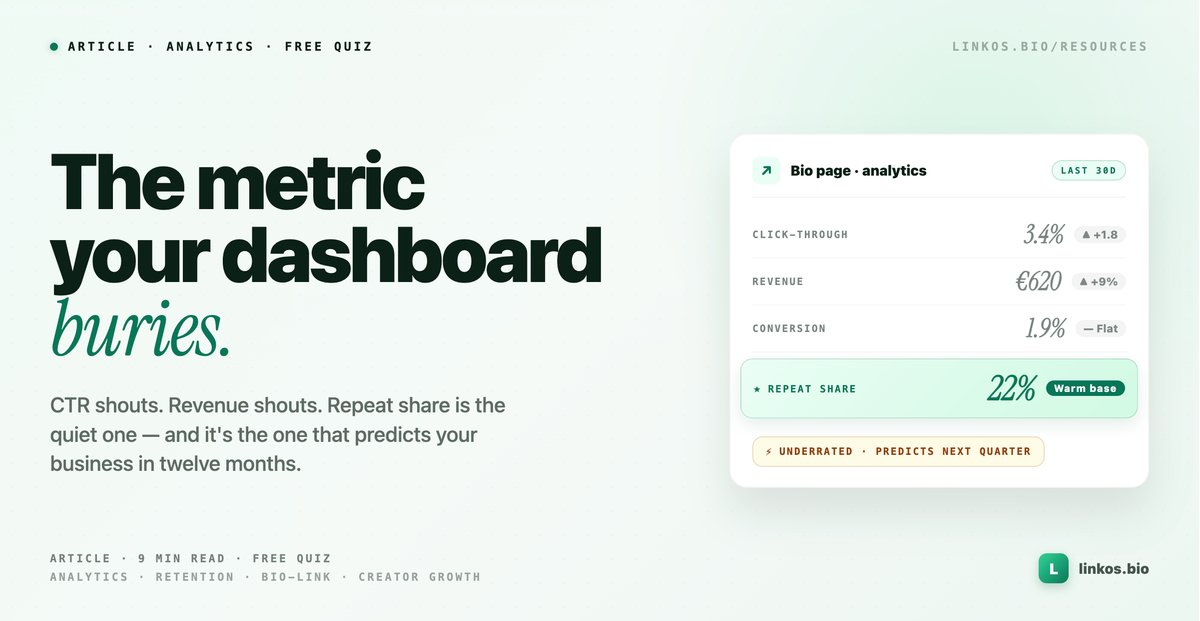
The most underrated metric in your dashboard
Everyone tracks CTR, conversion, revenue. The metric that predicts your next 12 months is quieter, easier to measure, and mostly ignored — repeat visitor share. It measures warmth, not reach, and it's the cheapest metric to move once you know two structural changes. Here's how to read it.
Key takeaways3 min · read this first
- Repeat visitor share is page views from returning humans divided by total page views. It measures warmth, not reach.
- Under 10% repeat share means mostly cold traffic. Fine for ads, a red flag for organic. You are being seen but not remembered.
- 15 to 25% is a warm audience. Your page is a habit for a chunk of your followers, which is where retention lives.
- Over 30% is a strong tribe. Rare and durable. Almost always paired with an active email list or Discord.
- Cheapest lever to move repeat share is making the page worth revisiting. Weekly rotating pinned link plus a whats-new section works.
Ask any creator which metrics matter and you'll hear the same list: CTR, conversion rate, revenue, follower growth. Ask which one predicts their business in twelve months and they'll usually pick the wrong one.
The metric that predicts is quieter, easier to measure, and mostly ignored: repeat visitor share — the percentage of your bio-page views that come from someone who's been there before.
Every other metric on your dashboard measures a single interaction. Repeat share measures the composition of your traffic. That's a category difference. One tells you what happened last week; the other tells you what kind of business you're building.
Why repeat share predicts
CTR, conversion rate, revenue — these are all response metrics. They measure how well you converted a given visitor once they arrived. They say nothing about who's arriving.
Repeat share measures who's arriving.
Cold traffic that clicks looks identical to warm traffic that clicks on a CTR chart. Both count as a 1. But they behave differently downstream. Cold traffic bounces, forgets you, and needs to be re-earned every time. Warm traffic remembers, comes back next week, buys things when you launch, opens your emails, refers friends. The gap between those two audiences shows up nowhere on a dashboard unless you track composition.
That's why repeat share is the leading indicator. It doesn't tell you how well you're converting this month — it tells you whether next month has any warmth to work with.
How to read the number
Under 10% — cold traffic. Most page views are people you haven't earned. You might be running ads, riding an algorithm cycle, catching drive-by TikTok traffic. Any of those can work for a quarter. None of them compound. Under 10% and organic-heavy is a red flag: people are seeing you and not sticking. If your CTR is great here, don't celebrate — you're paying for reach and cashing it out on impulse clicks.
15–25% — the healthy zone for most creators. A quarter of your views coming from returning humans means you have a base — people who treat your bio page as a way to check in on you. That's the audience that opens emails, converts on launches, becomes referral engines. This is where the business lives.
Over 30% — rare and durable. When you see it, it's not because the bio page is magic. It's because the creator has built a habit loop somewhere else — an active email list, a Discord people log into daily, a podcast with weekly episodes. The bio page is the terminal that habit passes through. 30%+ is what "you have an audience" actually looks like.
Direction beats absolute. If you're new and sitting at 4%, the benchmark is next month vs this month, not vs. an established creator. Repeat share climbing at all means the loop is forming. That's the signal.
Reading your number at a glance
| Repeat share | What it means | Common cause |
|---|---|---|
| Under 10% | Cold traffic — you're being seen, not remembered | Heavy ads, algorithm bursts, viral drive-by |
| 15–25% | Warm base — a chunk of followers treat your page as a habit | Consistent posting + one recurring anchor |
| Over 30% | Tribe — rare and durable | Active email list, Discord, or weekly podcast |
What NOT to confuse it with
- Not follower growth. You can lose repeat share while gaining followers — a viral post that dumps 10k cold followers on you tanks the ratio. That doesn't mean things are worse. It means the composition shifted.
- Not CTR. Cold traffic can have great CTR and terrible retention. High CTR from a bounce audience is a paid ad in disguise.
- Not session length. Someone opening your page for 3 seconds and leaving still counts as a return — and that's fine. Returning quickly is a habit signal, not a failure signal.
- Not "engagement." Engagement is a bundle word that hides everything useful. Repeat share is one number with one meaning.
- Not email open rate. Overlaps but doesn't equal. Email open rate measures whether they open your emails. Repeat share measures whether they revisit your surfaces without a nudge. That's a stronger signal.
The cheapest lever
The single cheapest way to move repeat share up is to make the page worth revisiting.
Most bio pages are static. Six links, same order, sitting there for months. Occasionally rearranged when the creator gets bored. Static pages don't reward return visits — if you check on a creator once and see exactly what you saw last week, you don't come back a third time.
Three structural changes move the number. None of them require new content.
1. Rotating pinned link (weekly). Every Monday, put the new thing at the top. Doesn't have to be huge. "Article: 5 metrics that matter" this week, "Tutorial: how I record" next week, "Interview with X" the week after. Weekly cadence tells returning visitors there's a reason to look. Even a rotation of existing content produces the signal — you don't need to publish new work every week to fake aliveness for the bio page.
2. "What's new" section (3 lines, updated weekly). This week's newsletter, this week's post, this week's project. Ninety seconds to update. This is what returning visitors are actually checking for — some proof of aliveness. Three lines of proof is enough.
3. Timestamp the page. "Updated Feb 12" in small type at the top. This one is unfair — the perception of freshness moves before any content changes. Returning visitors register the date, feel that something moved, and stay slightly longer even if the links look identical.
Do the first two for eight weeks and watch your number. You will almost certainly move it — often by 5–10 percentage points. That gain is more durable than any CTR win, because it changes the composition of your traffic, not just the response rate. Cold traffic that clicks is a bounce risk. Warm traffic that clicks is a customer.
A worked example
Two creators. Same follower count. Same monthly views on their bio page: ~4,000.
Creator A: 8% repeat share. 320 returning visitors, 3,680 new. High CTR on the top link (9%), decent monthly revenue (~€600 from affiliate clicks). Their dashboard looks healthy.
Creator B: 22% repeat share. 880 returning visitors, 3,120 new. Slightly lower CTR (7%), similar monthly revenue.
On paper Creator A wins today. In twelve months, Creator B wins. Every launch A does has to re-convince a mostly-cold audience. Every launch B does hits a base of 880 people who've been paying attention for months. B's newsletter opens at 40%; A's at 12% because most of A's list forgot who they were.
Same follower count. Same views. Wildly different futures. The composition of traffic is the whole story.
Common objections
"My platform doesn't show this metric."
Most link-in-bio platforms do — look under "audience," "visitors," or "traffic sources." If yours truly doesn't, tag one link with a UTM (utm_source=bio&utm_medium=direct) and check the returning-vs-new split in your analytics tool. That's a 5-minute setup.
"I don't have any repeat traffic — I'm too new." Fine. Then the benchmark is last month vs this month. If your repeat share is climbing at all, the habit is forming. Absolute numbers matter less than direction for the first six months.
"My repeat share dropped after I went viral. Is that bad?" No — that's math. A viral post floods you with cold traffic, which lowers the ratio even if returning visitors held steady or grew. Look at the absolute count of returning visitors instead. If that number is up, you're fine. The ratio will re-balance as the viral spike decays.
"I'm B2B, not a creator. Does this still apply?" Yes. Rename "bio page" to "landing page" and "creator" to "founder." The mechanic is identical: cold traffic bounces, warm traffic converts. B2B's version of repeat share is direct/organic traffic vs. paid/referred. Same category difference, same predictive power.
"Isn't this just email open rate in disguise?" No. Email opens require you to nudge them. Repeat share happens without the nudge — someone thought of you and typed your handle. That unprompted return is a much stronger warmth signal than an open.
FAQ
How often should I check it? Monthly. Weekly is noise. Daily is unhealthy.
What's the fastest way to move it? Rotating pinned link (weekly) + "what's new" section (3 lines, updated weekly). Two structural changes, no new content required.
Does the number differ by platform? Yes. Instagram-driven traffic runs lower repeat share than newsletter-driven traffic (Instagram optimizes for reach, newsletters for retention). Compare like-for-like — this month's Instagram-heavy 12% is not worse than last month's newsletter-heavy 20%.
How long before changes show? 6–8 weeks for the habit to form and show as returning visits. Don't judge sooner. The mistake is running a two-week test, seeing no movement, and reverting — habits don't compile that fast.
Should I target 30%? Only if you already have a habit surface elsewhere (list, community, podcast). Chasing 30% by tuning the bio page alone will fail because the bio page isn't where habits form — it's where they get spent. Build the habit somewhere else; the ratio follows.
Start today, in 5 minutes
- Find your bio-page returning-visitor number for the last 30 days. (In Linkos: Analytics → Audience → Returning share. In other tools: Audience → Visitors → Returning.)
- Write it down. That's your baseline.
- Add a "What's new — updated Feb 12" section to your bio page. Three lines. Timestamp it.
- Set a Monday recurring reminder to rotate the pinned link.
- Check the number in 8 weeks, not before.
That's it. The system is running.
The quiet one wins
Track the four rent-paying metrics first. Then track repeat share alongside them.
It's the quiet metric on the dashboard. It doesn't spike, it doesn't celebrate, it doesn't get screenshotted and posted. It just quietly tells you whether next quarter has any warmth to work with — the one thing every other metric is downstream of.
Watch it monthly. Move it deliberately. Ignore the ones that shout.
Sign up to start earning XP for every read.
📗 Free: the Link-in-Bio Starter Kit
The checklist, 6 layout templates, and our 1-page cheat sheet — sent straight to your inbox.
Recommended tool
Turn each topic into a finished post — in seconds.
PostPop writes the copy and designs the carousel in your real colours, fonts and logo. The making step, gone.
- On your brand, automatically
- Six formats · every platform size
- Free to start · no credit card
◆ A product by Linkos