How to read creator content that actually sticks
Most articles you read this week will be forgotten by Sunday. Not because they were bad — because reading without a system is entertainment, and entertainment doesn't stick. Here's the 4-step system top creators use to convert what they read into what they ship, without ever rereading.
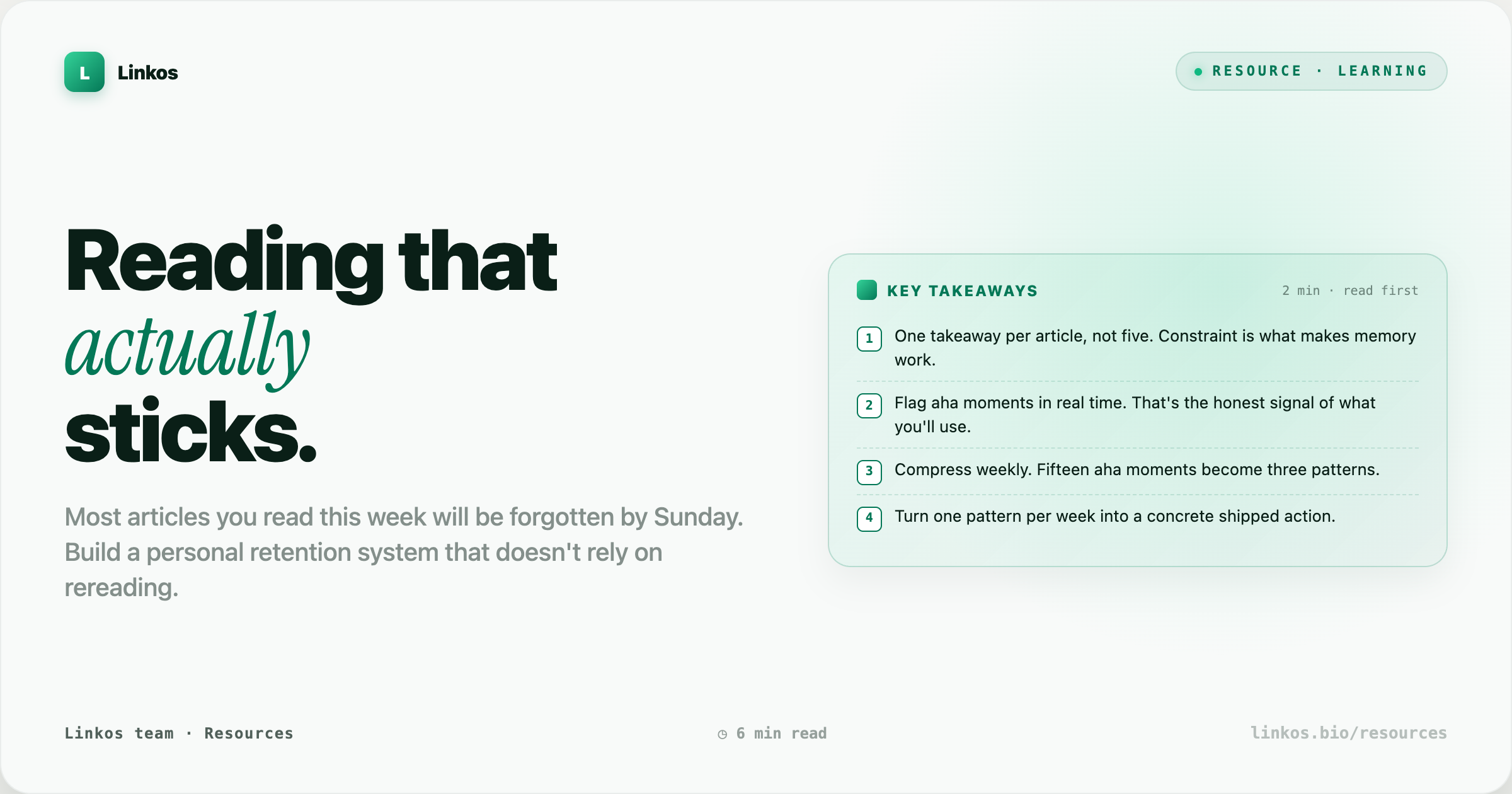
Key takeaways3 min · read this first
- Take one takeaway per article, not five. A page of vague notes forgets faster than a single sharp sentence.
- Flag aha moments as you read. The best signal of what you will actually use is what surprised you in the moment.
- Weekly, revisit only the aha moments. Do not re-read whole articles. Compress 15 aha moments into 3 patterns.
- Convert one pattern per week into a concrete action. Reading without application is entertainment.
- Trust your library, not your memory. A well-tagged saved list is worth 10x an untagged mental note.
You've read 50 creator articles in the last year. Ask yourself right now to summarize even three of them — the ones that felt important when you finished reading. You'll blank on most. Not because they were bad; most were probably fine. Because reading without a system converts to entertainment, and entertainment doesn't stick.
The gap between "I read that" and "I use that" is the whole game. Highlights are not a system. Saving to Instapaper is not a system. Nodding at a good sentence and telling yourself you'll come back to it is definitely not a system.
A system is three things:
- Repeatable — the same tiny action every time, so you don't have to decide.
- Forgiving — misses one week and still works the next.
- Outputs a small useful thing every week, whether you feel inspired or not.
This is one. It takes five minutes a week to run.
Why memory fails you (and what constraint fixes)
Your brain doesn't file information — it tags it against other things you already care about. That's why the article you read at 3am is gone by breakfast: nothing tagged it to anything you'll act on.
When you highlight five paragraphs in an article, you gave your brain five equally-weighted tags. Which means none of them are weighted. Come back a week later and you'll remember the shape of the article ("something about copy?") but nothing usable.
One takeaway per article is the hack. You didn't downgrade the information — you upgraded what stays. One sharp sentence hooks into more things than five vague ones because there's nothing competing with it.
Step 1 — One takeaway per article
The takeaway has to be a full sentence, not a keyword.
- ❌ "Growth"
- ❌ "Bio pages"
- ✅ "Growth stalls at the point your top link stops matching what your audience actually says they want."
It's specific, has a subject, and you can act on it. Write the clumsy version if the elegant one won't come. Clumsy is fine. Vague is not.
If you can't write the takeaway, the article didn't produce one. That's OK — most weeks half your reading won't. Skip.
Step 2 — Mark aha moments as they happen
You've had this experience: you highlighted a paragraph, kept reading, and a week later can't remember why you highlighted it. Highlights lie because we highlight defensively — "this might be useful someday." Aha moments don't lie because they happen in real time. Something in the article rearranges how you were thinking about a problem, and you feel it — a small internal "oh."
That's the signal. Not what you highlighted, not what the author underlined, not what the summary emphasized. What surprised you in the moment.
The physical sensation matters. If you didn't feel a small "wait — I hadn't thought of it that way," it wasn't an aha. Don't retroactively promote a highlight to an aha because it seemed important. The whole point is that ahas are honest.
Tap the aha button on the article. Timestamp the podcast. Whatever your surface allows.
Step 3 — Weekly compress (5 minutes)
Once a week, block five minutes and open only the aha list. Ignore highlights. Ignore "come back to this" saves. Just the aha's.
You'll have somewhere between 5 and 20. Read the list top to bottom. Do not re-open the source articles.
Somewhere in that list, three or four of them will overlap in a specific way. That overlap is a pattern.
Write it down as one sentence:
"This month's aha's are all about the top link doing too many jobs at once."
That sentence is worth more than the 15 highlights combined. It's compressed knowledge — a thing you can act on, not a thing you might use.
If you can't find a pattern, your week's ahas were noise. That's diagnostic. Either you read too narrowly (all confirming what you already believed) or too wide (nothing overlapped enough to matter). Adjust next week's reading.
Step 4 — One pattern → one shipped change
Every week, take one pattern from the weekly review and convert it into a concrete change. Not "think about this." An action:
- Rewrite one link on your bio page.
- Cut two words from your next email subject line.
- Test one new hook in your next post.
- Draft one paragraph of a positioning update.
The change should be shippable this week. If it can't be, break it smaller.
Twelve weeks of this is twelve concrete changes to your business, all downstream of things you read. Most creators read and forget. You read, compress, and ship.
What a week actually looks like
Real example, one week:
Monday–Sunday — you read 11 articles. Six had aha moments. Six single sentences saved:
- Retention comes from surprise, not consistency.
- The best top-link copy names the concrete thing.
- Newsletter open rates are downstream of the subject line's first three words.
- Audience trust compounds; it doesn't grow linearly.
- Every abstract noun in a CTA costs you a first-time visitor.
- Small creators have three advantages the platforms structurally can't copy.
Sunday morning, 5 minutes — you skim the six. #2 and #5 both point at the same thing: concreteness in the top link matters more than volume of links. That's the pattern.
One shipped change this week — you rewrite your top link from "Latest content" to "Buy the €12 plant calendar (ships Nov)."
Total time: ~10 minutes for the review + rewrite. Total return: a bio page that a stranger can understand in three seconds.
Repeat this loop weekly.
The 4-step loop, at a glance
| Step | What you do | Time cost |
|---|---|---|
| 1. Read | Capture one takeaway sentence per article | 30 seconds/article |
| 2. React | Tap "aha" when something rearranges your thinking | 3 seconds |
| 3. Review | Weekly: read only the aha's, find the pattern | 5 minutes |
| 4. Apply | Convert one pattern into one shipped change | ~30 minutes |
Common objections
"I read a lot of things — one takeaway per article isn't enough." It's the opposite. One sharp takeaway compounds; five vague ones evaporate. The constraint IS the system.
"I don't know what counts as an aha moment." The physical sensation is the signal: "wait — I hadn't thought of it that way." If you didn't feel that, it wasn't one. Don't fake them. A week of low-aha reading is honest data — use it.
"My weekly review takes forever." You're re-reading the source articles. Stop. The review is 5 minutes MAX — just the ahas.
"I only read one great thing this week, not five." That's fine. The system tolerates weeks with one aha; the loop is what compounds, not the volume of any given week.
"What if my aha is wrong?" Ship the change anyway. Reversing course after shipping teaches you more than debating the aha in your head for another week.
What to read (upstream of the system)
The system works on whatever you feed it, but garbage in produces garbage patterns. Two filters:
- Read one level above where you are. Not five levels — you won't have the context to spot ahas. Not the same level — nothing will surprise you. One rung up.
- Read specifics, not frameworks. Frameworks summarize other people's ahas. You want the raw material — case studies, teardowns, specific decisions people made. Those produce your own ahas, which are far more useful than borrowed ones.
Pop quiz · 7 questions · ~60 seconds
How well do you know this?
Answer 7 multiple-choice questions. See your tier at the end. Bragging rights optional.
FAQ
How many articles a week is this good for? Five to 20. Fewer than 5, no pattern to compress. More than 20, you're skimming — nothing produces ahas anyway.
Do I need a specific tool for this? No. A saved-articles library with an "aha" tag beats a purpose-built app you'll abandon in two weeks. That said, if a surface has an aha button built in (Linkos does), use it — one less step is one less reason to skip.
What if a week has no ahas? Read less next week, or read differently. Zero ahas usually means everything you read confirmed what you already believed. Add a source outside your usual orbit.
Does this work for video / podcast content? Yes. Same system — one takeaway sentence per episode, aha timestamps, weekly review.
Can I do the review monthly instead of weekly? No. The patterns lose their edge past 10 days. Weekly is short enough that the aha is still warm and long enough to produce a pattern. Monthly compresses too much into one review; you'll pick the loudest ahas and lose the interesting ones.
What if I'm just starting — no library, no history? Start today. Read one article, write one takeaway, tap one aha if it lands. That's the whole system on day one. The compounding starts week two.
Start today, in 5 minutes
- Open a note or a library. Make one section called "Aha 2026" (or whatever year).
- Read one article — anything you'd normally save. Write the one-sentence takeaway. If nothing surprised you, close the note and try tomorrow.
- Do the same tomorrow. And the day after.
- Next Sunday, spend five minutes looking at what's there. Find the pattern. Ship one thing.
That's it. The system is running.
Trust the library, not your memory
Your memory is not the tool. Your library is the tool. A saved list with clean tags is worth ten times an untagged mental note, because the untagged mental note is unfindable and the library is searchable.
Save aggressively. Tag every save. Come back to the library, not to your memory. Twelve weeks from now, the library will surprise you with a pattern you'd forgotten was forming — and you'll ship something better because of it.
That's the whole game.
Sign up to start earning XP for every read.
📗 Free: the Link-in-Bio Starter Kit
The checklist, 6 layout templates, and our 1-page cheat sheet — sent straight to your inbox.
Recommended tool
Turn each topic into a finished post — in seconds.
PostPop writes the copy and designs the carousel in your real colours, fonts and logo. The making step, gone.
- On your brand, automatically
- Six formats · every platform size
- Free to start · no credit card
◆ A product by Linkos