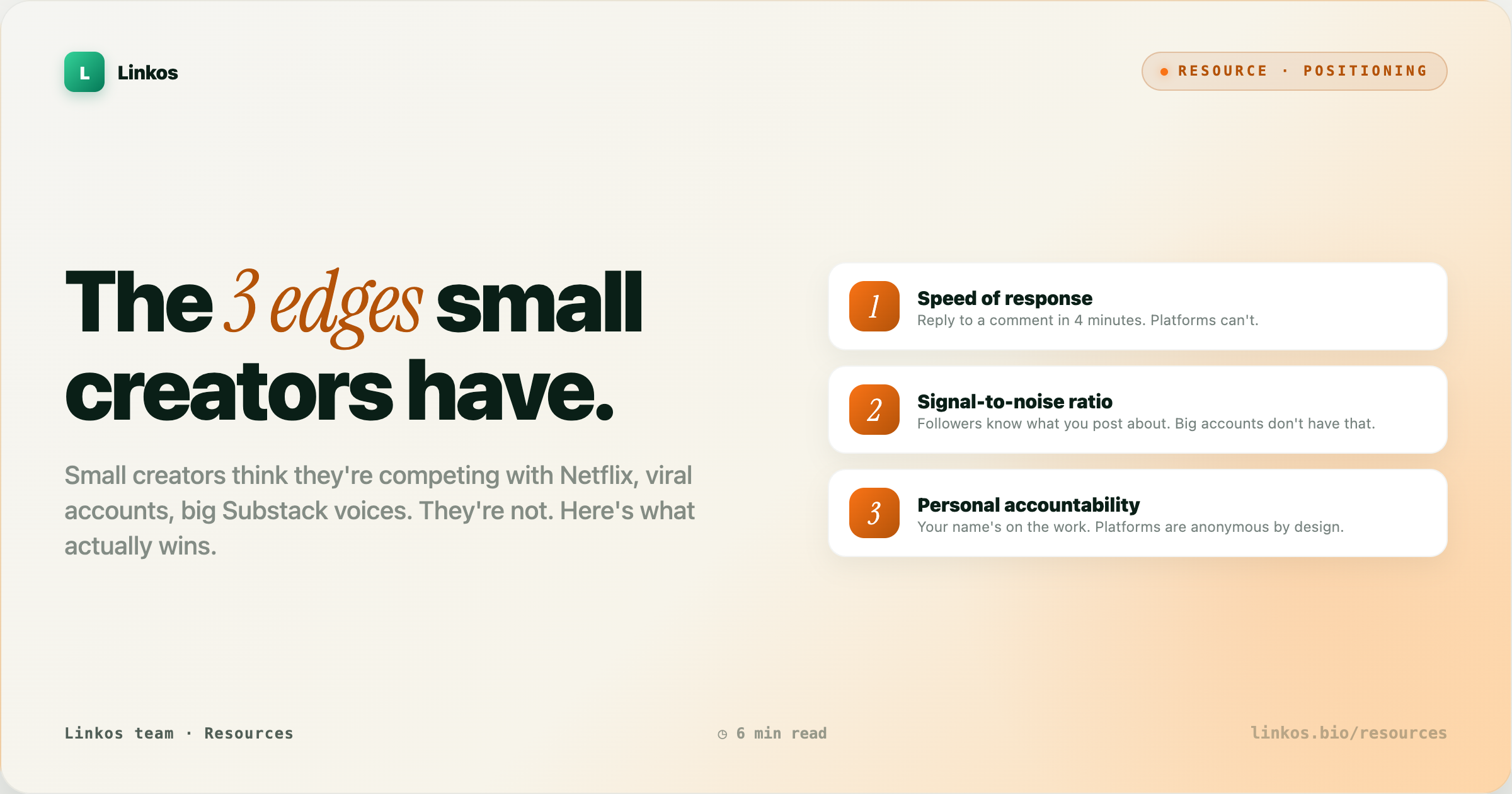
The 3 advantages small creators have over big platforms
Small creators think they're losing to Netflix, viral accounts, and million-follower Substacks. They're not — they're competing on completely different geometry. Three durable edges platforms structurally cannot copy, and why the strategy is to lean harder into what only small can do.
Key takeaways3 min · read this first
- Speed of response — you can reply to a comment in 4 minutes. A platform account cannot. Speed is a real advantage.
- Signal-to-noise ratio — your audience knows what you post about. A big account has to keep everyone interested.
- Personal accountability — your name is on the work. Platforms are anonymous by design. Accountability compounds trust.
- These three edges do not scale. That is why they work. If they scaled, big platforms would already have them.
- Small creators lose when they try to imitate scale. They win when they lean harder into what scale cannot do.
Big platforms outspend you a thousand to one. They have teams, budgets, algorithmic reach you can't touch. Follower count, ad budget, distribution — every metric points their way. And yet: on the metrics that actually matter — trust, conversion, repeat-visit — creators regularly outperform platforms.
Not sometimes. Structurally. And it's not a mystery.
You have three specific advantages a platform account cannot copy. Not "won't." Cannot. The advantages are structural. They break the moment they scale — and platforms scale by definition, so the advantages are yours.
The trap is not knowing you have them. You spend your time trying to imitate the scale side (chasing follower count, batching replies, softening your voice for a wider audience) — and give up the exact edges that were working for you.
Here they are.
1. Speed of response
You can reply to a comment in 4 minutes. A platform account cannot.
The math is unavoidable: reply speed is inversely correlated with organization size. One person → immediate. Two people → coordination. Five people → brand voice review. A team → approval chain, legal check, brand-safety pass. By the time a platform's community team replies to a DM, the person who sent it has moved on with their life.
The user who got a reply from you in 4 minutes remembers it. Not because the reply was clever — because it happened. That memory becomes trust, and trust becomes the reason they come back, share your link, buy the thing. Repeat visits are the whole business; 4-minute replies are one of the cheapest ways to earn them.
The test: reply within 60 minutes to your next 10 comments — not batched at end of day. Watch engagement on the following post. It goes up. Every time.
Why it doesn't scale: the moment you hire someone to help reply, you're back on the coordination curve. That's not a bug. It's the mechanism. Solo speed is the edge; it evaporates the second you're not solo.
2. Signal-to-noise ratio
Your audience knows exactly what you post about. They followed you because you post that specific thing. Every post lands on people who already opted in.
A big platform account can't do this. They have five million diverse followers with contradictory interests. Optimizing for one segment loses another. So they optimize for the mean — a version of content that mildly interests everyone and deeply excites no one.
You can go three posts deep on one narrow topic and lose no one, because nobody who cares about you was going to care less about a deeper cut. You can be specific in a way platforms cannot. Specificity is what people actually save, share, and reference.
The test: your next post — pick the more specific version. Not "how to write a bio," but "how to write a bio for a paid Substack writer with an unrelated day job." The narrow post outperforms the wide one every time when your audience is small, because the narrow post is for them.
Why it doesn't scale: signal-to-noise depends on a homogeneous audience. Grow past a certain point and the audience segments. To keep the whole crowd, you broaden. Broadening kills signal. Same mechanism.
3. Personal accountability
Your name is on the work. You can't hide.
Platforms are structurally anonymous. Support tickets are answered by "The Team." Product decisions are made by "Product." Bad recommendations get memory-holed by an internal comms review. There is no single throat to choke, so nobody feels the consequences of any single decision.
You do. If you recommend something bad, your name loses trust. If you recommend something good, your name gains it. Every recommendation is priced against your reputation, and reputation is the only asset that compounds without you touching it.
That constraint sounds heavy until you notice it's also the mechanism. You'll never recommend a bad tool for a $200 affiliate check because $200 doesn't come close to the reputation cost. A platform can't feel that math — no single person there loses anything from a bad recommendation.
The test: next time you're offered a paid partnership, ask yourself if you'd recommend the thing without the payment. If no, decline. That's not a moral position — it's a business one. Reputation is your compounding asset.
Why it doesn't scale: personal accountability requires one person on the hook. Add a team, distribute the reputation across five names, and the pressure that made each decision careful goes away.
The pattern
Notice the through-line: all three advantages break at scale.
- Speed of response requires one person to reply.
- Signal-to-noise requires a narrow, self-selected audience.
- Personal accountability requires one name on the work.
If any of them scaled, platforms would already have them — and they don't, because they can't. That's why they're yours. Not because you're clever. Because you're small.
The word "small" sounds like a limitation. It's the mechanism.
Where small creators lose
Every time. Same failure mode:
- Trying to be a "content brand" instead of a person. Softening voice for imagined broader appeal. Removing the specificity that made anyone care in the first place.
- Chasing follower count as the metric. Followers don't compound — trust compounds. A 3,000-follower audience where every reply is a real conversation is worth more than 30,000 followers who scroll past you.
- Batching replies for "efficiency." The efficiency saves you 15 minutes and costs you the compounding trust. Bad trade.
- Adding a team too early. Every hire dilutes at least one of the three edges. Sometimes worth it. Usually not, at your stage.
- Optimizing your bio like a platform would. Generic, safe, appeals-to-everyone. This is the opposite of the edge. Your bio should turn away the wrong people.
Every one of these mistakes is a small creator trying to become a small platform. The economics don't work at that scale. You lose your edge, and you can't reach the scale that would replace it.
How to lean in this week
Concrete, small, this-week actions:
- Reply to every DM under 60 minutes for one week. Track the effect on your next post's engagement.
- Pick the narrower version of your next post title. Not "creator tips," but "email subject-line tips for solo newsletter writers under 1,000 subscribers."
- Write one post in first-person about a mistake you made. Not "5 lessons from failing" — the actual specific mistake, named. Watch it out-perform your polished posts.
- Remove one softening word from your top-link copy. "Might" → cut. "Sort of" → cut. "Maybe" → cut. Specificity is the edge; hedging is you performing scale.
- Turn down one partnership offer you were considering because the fit is off. Feel the reputation math working in real time.
The 3 edges, at a glance
| Advantage | What you can do | What a platform cannot |
|---|---|---|
| Speed of response | Reply to a DM in 4 minutes | Route through team + brand-voice review |
| Signal-to-noise | Post narrow content that keeps everyone | Optimize for a mean of 5M mixed interests |
| Personal accountability | Recommend only what you'd bet your name on | Distribute reputation cost across a team |
Common objections
"But I want to grow. Doesn't growth require scaling?" Growth requires attention. Attention comes from doing something specific, unusually well, in public. Those are the edges — not obstacles to growth, they're the mechanism of it. When you grow past the point where they break, you'll know because your trust curve will start to bend. That's a real problem to solve then. Solving it now is premature.
"What if I run out of energy replying to everything?" You will. Not every reply needs to be 4 minutes — but some do. Pick the highest-signal ones (a new subscriber's first DM, a thoughtful long comment, a specific question). Batch the rest guilt-free. The edge is real replies at real speed to real people, not exhaustion.
"Does this apply if I already have a team?" The edges dilute proportionally to team size — but you can preserve them. Keep replies attached to a specific person, not "the team." Keep the reputation on one name (yours) even if others help produce the work. Keep the audience narrow instead of broadening to justify the team's cost. The edges are recoverable up to a point.
"But small creators I follow use brand voice, generic bios, batched replies…" And they're stuck. You noticed because their content stopped surprising you. That's the plateau these mistakes cause. Don't copy the plateau — copy the earlier version of them that got you to follow in the first place.
Pop quiz · 7 questions · ~60 seconds
How well do you know this?
Answer 7 multiple-choice questions. See your tier at the end. Bragging rights optional.
FAQ
How do I know if I'm past the scale where these edges break? Two signals: DMs regularly go 6+ hours before you can reply, and you're posting content that mildly interests everyone (rather than deeply interests a segment). Both mean you're managing a small platform, not being a creator.
Do these edges work in every niche? Yes — with different weights. Signal-to-noise matters most in technical/professional niches (people follow for a specific expertise). Speed of response matters most in lifestyle/community niches. Personal accountability matters most where money changes hands (product reviews, affiliate content, courses).
What if my niche is dominated by big accounts? Then the advantages are worth more, not less. Every big account in your niche is structurally unable to do what you can. Their dominance is on the metrics they can win (reach, budget, distribution). Your win is on the metrics they can't (trust, specificity, personal stake). Different game, played in parallel.
Do platforms know about these advantages? Yes. Every platform has a "creator program" trying to graft them on. It doesn't work. The advantages break the moment they scale, and platforms exist to scale. That's the whole point. They can subsidize creators (sensible) but they cannot become creators (structurally impossible).
The takeaway
The moment you optimize for scale, you become a worse version of what platforms already are.
Optimize for what only you can do:
- Reply faster than any team can approve.
- Go narrower than any mean can serve.
- Put your name on work you'd bet on.
Small is not a phase to escape. It's the mechanism you're built on. Lean in — the edges get sharper the harder you press.
Sign up to start earning XP for every read.
📗 Free: the Link-in-Bio Starter Kit
The checklist, 6 layout templates, and our 1-page cheat sheet — sent straight to your inbox.
Recommended tool
Turn each topic into a finished post — in seconds.
PostPop writes the copy and designs the carousel in your real colours, fonts and logo. The making step, gone.
- On your brand, automatically
- Six formats · every platform size
- Free to start · no credit card
◆ A product by Linkos