How to write a link in bio that converts
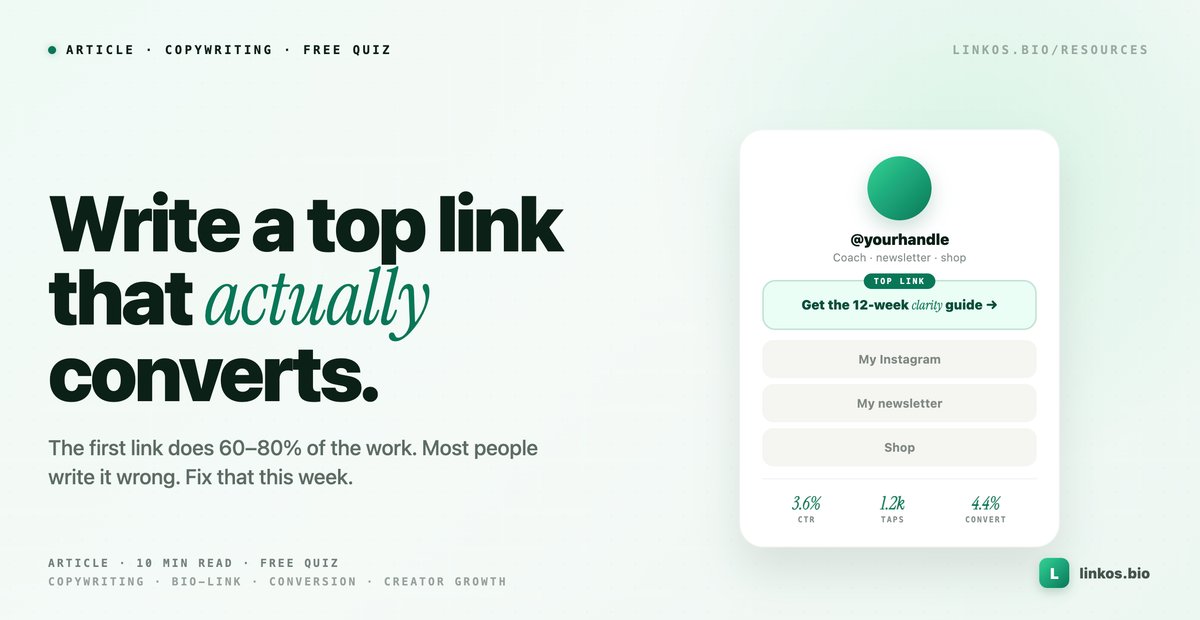
The first link on your bio page does 60–80% of the work. Most people write it wrong. Fix that this week.
Most creators spend an afternoon agonising over which links belong on their bio page. Should the newsletter go above the shop? Where does the podcast fit? Do people still click on About pages? These are fine questions, but they're the wrong ones to start with. The link that decides whether your bio page works isn't the fifth one. It's the first one. And most creators write it in about eleven seconds, with a phrase like "My newsletter" or "Latest project" — and then wonder why the page feels flat.
Here's the uncomfortable part. The top link on almost every bio page does 60 to 80 percent of the total clickthrough work. Everything below it is a long tail. So the top link is the piece of copy on your entire internet presence that deserves the most thought, and it's usually the piece that gets the least. This article is a fix for that. We'll walk through what a converting top link is actually made of, five patterns that reliably work, three that reliably don't, and how to test yours this week without over-engineering it.
The anatomy of a converting top link
A top link that works is not clever. It's specific. Three ingredients show up in almost every one that outperforms the rest of a bio page, and the interesting part is how boring they are individually.
The first is a specific promise. Not "resources" — the twelve-week clarity guide. Not "my writing" — the essay collection for freelancers who hate their pricing. Specificity is a proxy for effort, and readers can feel effort in a phrase. Vague promises make readers assume the thing behind the link is also vague, and they scroll.
The second is a specificity anchor — a number, a proper name, a timebox, or an audience descriptor. "12-week", "in 3 emails", "for coaches", "the 2026 kit". Anchors give the reader an immediate mental estimate of what they're getting. A guide with no length is a guide of unknown cost. A guide labelled "12-week" is priced in the reader's head before they've clicked.
The third is an outcome verb. "Get", "Steal", "Send me", "Read", "Book", "Grab", "Watch". Verbs that describe what the reader does or receives, not what the button does. "Click here" is a button describing itself. "Get the 12-week clarity guide" is a person describing what happens next.
Three quick before-and-afters, with plausible small-creator numbers:
- Before:
My newsletter. After:Get 3 emails a week on freelance pricing. This kind of rewrite reliably moves top-link CTR from around 1.8% to 3.6% over three weeks — a doubling, and it's not because the newsletter changed. - Before:
Free resources. After:Steal my 12-week clarity guide (free). Same asset. The word "steal" adds voice, the number adds structure, and the "(free)" removes the last friction. - Before:
Latest podcast. After:Listen: how I priced my first $10k month. The vague label becomes a story with a hook, and CTR moves from roughly 2.1% to 4.4% over the same window.
None of these are clever. They're just legible. A converting top link tells the reader, in one line, what they're getting, how much of it there is, and what to do next. That's the entire trick.
Five patterns that consistently work
There are more than five patterns, but these five cover most of what a small-to-mid creator needs. Pick the one that fits your primary offer and write your top link around it.
The free-thing hook
Get the free [thing] →
This pattern works because it does two things at once. It states what the reader gets, and it removes the price objection before the reader has raised it. "Get the free bio-page teardown checklist" is a promise plus a zero-risk gate. Free things also convert well for a boring structural reason — the reader is on a bio page, which means they don't fully know you yet. Asking them to pay or subscribe as their first move is a big ask. Asking them to grab something free is a small ask. Small asks compound. If you have any lead magnet at all — a checklist, a PDF, a swipe file — the free-thing hook is often your safest first bet for the top slot. Just don't let "free" carry the whole sentence. "Free download" is not a promise. "Get the free 12-week clarity guide" is.
The count-in-title
12 templates for creators / 7 emails I'd send this week
Numbers do two things that vague nouns can't. They make the reader estimate. Twelve templates is a concrete thing — the reader knows roughly how long it'll take to skim, and roughly how much value they might extract. Vague "templates" could be three or three hundred. And numbers create a small commitment loop: once you promise seven emails, the reader arrives ready to receive seven emails, and they finish more of them. Odd numbers tend to feel more considered than round ones, but this is a small effect and not worth agonising over. The bigger win is just putting a number in at all. If your offer has a natural count — modules, lessons, templates, emails, chapters, days — put the number in the top link.
The outcome-verb
Fix your bio page in 20 minutes
Verb plus specific benefit plus timebox. This is the pattern most creators underuse, and it's the one I'd default to if you're not sure which to pick. It works because it collapses the entire pitch into one sentence — the reader knows what they'll be able to do, and how long it'll take. Timeboxes are surprisingly powerful. "In 20 minutes" is a promise of a low cost. "This weekend" is a slightly bigger cost. "In under an hour" is honest and specific. Avoid dishonest timeboxes — "in 30 seconds" is almost never true, and readers know. When the timebox is real, it's the highest-signal word in the sentence. If you can't attach a timebox, attach a count. "Fix your bio page with 5 rewrites" also works.
The identity match
For coaches / For newsletter writers / For illustrators
Identity-match top links filter aggressively — and that's the point. If you write "The 12-week clarity guide for coaches", you're going to lose everyone who isn't a coach. That's fine. The people who are coaches will feel seen in a way that a generic guide never manages. Filtering isn't a cost. It's a feature. Bio-page traffic is often small and mixed, and a link that only converts your target audience will beat a link that half-converts everyone. Identity anchors also do the specificity work for you — "for coaches" is more evocative than "for professionals". Where possible, name the specific occupation, not the general category. "For freelance illustrators" beats "for artists". Use this pattern when your offer is genuinely occupation-shaped. Don't force it if your work cuts across audiences.
The scarcity note
Founder pricing · 500 seats left / This week only
Scarcity works, but only when it's real. The moment a reader realises a countdown is fake — the "500 seats left" that never drops, the "this week only" banner that's been up for a month — you've spent trust that was hard to earn. Fake scarcity kills more bio pages than any other pattern in this list, because it burns the one thing a small creator has that big brands don't. If your scarcity is real — a founder cohort with actual seat caps, a course that actually closes, a bonus that actually expires — say so plainly and put it in the top link. If it isn't real, don't fake it. Use one of the other four patterns instead. There's no version of fake scarcity that's worth the reputational cost.
Three patterns that consistently fail
Some patterns show up on bio pages so often that they feel default. They aren't defaults. They're mistakes with momentum.
Vague verbs. "Click here", "Learn more", "Read this". These are labels for buttons, not offers to readers. "Click here" tells the reader what their finger is going to do, which they already knew. It tells them nothing about what they'll get. If your top link uses "click", "tap", "read", or "see" without a specific noun attached, it's leaving CTR on the floor. Rewrite it around the outcome the reader gets.
No stated benefit. "My newsletter." "Latest project." "Podcast." These are nouns with no promise. They assume the reader already cares about your newsletter, which is a big assumption on a bio page where half the visitors are one-tap-from-Instagram strangers. Every top link should answer the reader's implicit question — what's in it for me — in the same breath as it introduces the thing. Not "my newsletter". "3 emails a week on freelance pricing."
Jargon before value. "Cutting-edge growth loops for creators." "AI-powered systems for scaling attention." "Battle-tested frameworks." Jargon dressed as insight is worse than a plain vague link, because it also signals that the person behind the page doesn't trust the plain version of what they do. If you can't say what your offer is in one boring sentence, the top link isn't your problem yet. Write the boring version first, then decide whether to add voice.
The Sloth+ walkthrough
If you want the guided walkthrough of top-link copywriting, Link-in-Bio Fundamentals walks through it module by module. The path is free with Sloth Mode.
How to A/B test your top link
You don't need a stats degree. You need two versions, a week, and the patience not to touch anything else.
Write two versions of your top link. Use different patterns — for example, the free-thing hook against the outcome-verb. Same promise, different framing. Don't test two versions of the same pattern; the difference will be too small to see.
Run each version for at least seven days. Twenty-four hours of data is noise, especially at bio-page scale. Weekly cycles matter — traffic on a Tuesday looks nothing like traffic on a Sunday.
Compare CTR, not clicks. Total clicks depend on how much traffic you drove that week, which is usually the biggest variable in the whole test. Ratios stay honest even when traffic swings.
If neither version wins by more than 20%, they're a tie. Pick the one you'd rather explain to a friend, and move on to testing the next thing. Small differences at small volumes are almost always noise.
One more rule. Don't test more than two versions at once. Three-way tests need three times the traffic to hit the same confidence, and most creator bio pages don't have the volume. Two versions, seven days, one clear ratio.
Pop quiz · 5 questions · ~60 seconds
Would your top link pass the promise + specificity + verb test?
Answer 5 multiple-choice questions. See your tier at the end. Bragging rights optional.
What to do this week
Rewrite your top link using pattern three — the outcome-verb. Here's the template:
[Verb] + [specific benefit] + [timebox or count]
Two examples: Fix your pricing page in 20 minutes and Write 7 newsletter subject lines tonight. That's the entire assignment for this week. Don't touch the rest of the page. Don't add a link. Don't change your header. Just rewrite the top one, using the template, and watch what happens over the next seven days.
Where to go next
The full walkthrough of top-link copywriting, ordering, and the psychology of a bio page lives in Link-in-Bio Fundamentals — the free path in Sloth Mode. If you're weighing whether to upgrade for the deeper Sloth+ paths, plans explained lays out what's included at each tier without the marketing gloss. And if you'd rather start by tightening the rest of the page, the templates gallery has bio layouts you can adapt in an afternoon.
The top link is the sentence on your bio page that deserves the most care. Give it fifteen minutes this week, and see what shifts.
Sign up to start earning XP for every read.
📗 Free: the Link-in-Bio Starter Kit
The checklist, 6 layout templates, and our 1-page cheat sheet — sent straight to your inbox.
Recommended tool
Turn each topic into a finished post — in seconds.
PostPop writes the copy and designs the carousel in your real colours, fonts and logo. The making step, gone.
- On your brand, automatically
- Six formats · every platform size
- Free to start · no credit card
◆ A product by Linkos