AI Customer Support Without the Hallucinations: A 2026 SMB Guide
AI support that makes things up is worse than no AI support. A plain-language guide to RAG-based assistants, multilingual support, and when AI actually helps your customers (featuring HolaOra).
AI customer support without the hallucinations
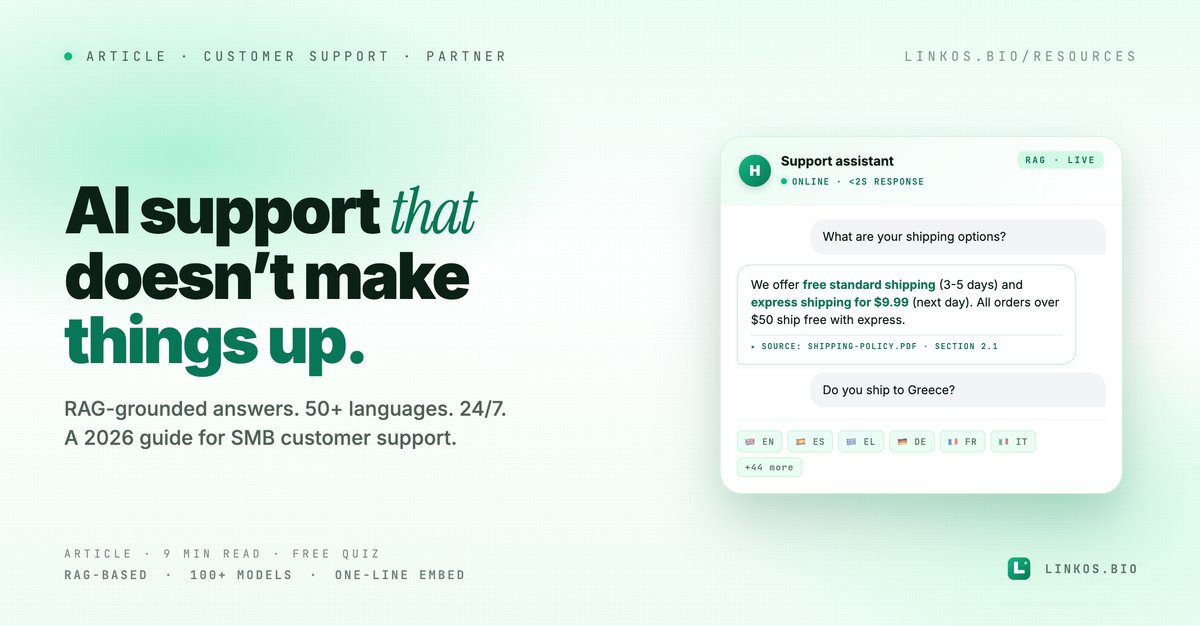
A 2026 guide for SMBs — when AI actually helps, and when it just makes customers angrier
Open most "AI customer support" chatbots in 2026 and ask three product-specific questions. Two of the answers will be confidently wrong.
The bot will quote prices that don't exist. It will promise shipping to countries you don't serve. It will hallucinate a return policy with cleaner language than the real one. The customer trusts the answer — that's the whole point of the chat widget being there — and then walks into a refund request based on a policy you never wrote.
This is what most SMBs mean when they say "we tried AI support and it was terrible." It wasn't terrible because AI is bad at language. It was terrible because the AI was allowed to make things up.
The fix isn't a better model. The fix is a different architecture — one where the AI can only answer from your actual documents, and refuses (or hands off to a human) when the answer isn't in there. The technical name for this is RAG: Retrieval-Augmented Generation. This guide walks through what that actually means, what to look for in a tool, and when to adopt vs wait.
What "RAG" actually means in plain language
A normal LLM chatbot works like this:
- Customer asks: "What's your return policy?"
- The AI pattern-matches against everything it's ever been trained on
- It generates an answer that sounds like a return policy
- Confidence is decoupled from accuracy — the AI sounds equally sure whether the answer is true or made up
A RAG-based chatbot works like this:
- Customer asks: "What's your return policy?"
- The system searches your uploaded documents (PDFs, FAQs, web pages) for relevant passages
- Those passages are passed to the AI as context
- The AI generates an answer grounded in the passages it just retrieved — and can cite them
- If nothing relevant is found, the AI says "I don't know" or hands off to a human
The difference is the word grounded. The AI doesn't get to invent. It can only summarize, rephrase, and translate what's actually in your documents. Hallucinations drop from "happens on 20-40% of edge-case questions" to "rare, and usually catchable."
This isn't a tweak. It's a different category of tool. Most cheap "AI chatbot" products in 2025 didn't do this. Most serious ones in 2026 do.
The 5 things that separate good AI support from bad
1. RAG-based retrieval, not free-text generation
Already covered. If the tool can't tell you exactly which document a given answer came from, it's not grounded — and your customers will eventually get fed wrong information with confident phrasing.
2. Multilingual support that actually works
Your customers don't all speak English. A Greek tourist asks in Greek about your Athens restaurant. A German customer asks in German about your shipping rates. A Spanish-speaking student asks in Spanish about your course deadlines.
A good 2026 tool handles 50+ languages using the same underlying knowledge base. You don't upload your docs five times. The AI translates the question, retrieves the relevant passage from your single source of truth, and answers in the customer's language.
The bar for "actually works" is: a French customer gets a French answer that's just as accurate as the English version, because both came from the same retrieval pass.
3. Source citation + confidence handling
When the AI answers, it should be able to point at the section of the document that the answer came from. Two reasons:
- You can audit it. Spot-check 20 answers per week against the cited sources. Catch any drift before it becomes a refund-request pattern.
- The customer can verify. "Per our return policy section 3..." reads as authoritative AND lets the customer click through.
When the AI doesn't have a source for a question, the right behaviour is to say so — not to guess. "I don't have specifics on that — would you like me to connect you with our team?" is a better answer than a hallucinated one.
4. Easy embed, no engineering project
A widget that requires three weeks of engineering work to install is a tool you'll never roll out properly. The right install is one line of code in the <head>, deployed by anyone who can edit a website.
For an SMB the speed matters. The goal is "decision to deployed" in under an hour, not under a quarter.
5. Pricing that scales with how you actually use it
The pricing trap in this category is metered-per-conversation. A viral post generates 10,000 chats overnight and you get a €4,000 bill. Look for tools priced on knowledge bases / assistants / features — not per-conversation. The good ones bundle "unlimited customer conversations" into every paid tier.
When AI support is the wrong choice
Be honest about this — it's not the right tool for every business.
Skip AI support if:
- You get fewer than 50 customer questions per month total. The setup time isn't worth the small inbox.
- Your support questions are mostly emotional or sensitive (medical advice, legal counselling, grief support, mental health). A human is the right channel.
- Your product is changing every week and you don't have time to keep the knowledge base current. AI is only as good as the docs you feed it.
- You don't have any written documentation yet. Build the docs first — for humans — then upload them to AI.
Use AI support if:
- You get 100+ repetitive questions per week (shipping times, hours, policies, basic product specs)
- You serve customers in multiple languages but only staff one or two
- Your team is constantly being interrupted with questions they've answered before
- You're losing weekend / overnight sales because nobody's there to answer
- You want to free up your team for the genuinely hard / valuable conversations
The classic 80/20 case: 80% of inbound questions have already been answered in your docs somewhere. AI handles those 80% in seconds, your humans handle the 20% that matter.
A worked example: HolaOra
We've been recommending HolaOra — holaora.com to SMBs in our network looking for AI support without an engineering project. Here's how it maps to the 5 requirements above:
1. RAG-based retrieval ✓
HolaOra uses RAG ("Accurate Answers Only — RAG-powered retrieval means answers come from your docs, not hallucinations. Cite sources, stay trustworthy"). You upload PDFs, web pages, FAQs — the AI indexes them and retrieves the relevant passages when a customer asks.
2. Multilingual support ✓
50+ languages out of the box. Same underlying knowledge base — the AI handles translation at query and answer time.
3. Source citation ✓
The RAG architecture is the citation mechanism. Answers stay grounded in the documents you uploaded.
4. Easy embed ✓
One line of code drops the widget into any site. Brand-colour customisation included. Mobile-friendly.
5. Pricing that scales reasonably ✓
HolaOra's plans bundle unlimited customer conversations on every paid tier — you pay for assistants and knowledge bases, not per-message. Real pricing:
- Starter — €9/month · 1 AI assistant, 1 knowledge base, 50 messages/day, website widget, 50+ languages, email support
- Growth — €29/month (most popular) · 5 knowledge bases, unlimited messages, 100+ AI models (GPT-4 / Claude / Gemini / Llama), email & calendar integration, custom branding, priority support
- Scale — €79/month · unlimited knowledge bases, API access, advanced analytics, team collaboration (up to 10), dedicated support, WhatsApp integration
All paid plans: 14-day free trial, no credit card required.
Other things that matter
- 100+ AI models supported — pick GPT-4 for accuracy, a faster/cheaper model for high-volume tiers
- <2 second average response time per the published spec
- 24/7 availability — the actual reason most teams adopt this
Try HolaOra free for 14 days at holaora.com →
(Full disclosure: HolaOra is built by an independent team in our extended network. We don't earn commission from signups — we're including them because in this category most "AI support" tools either don't do RAG properly, lock multilingual behind enterprise tiers, or charge per-conversation in a way that punishes traffic spikes.)
Is HolaOra the right tool for me? Quick FAQ
Is HolaOra free? It's free to start with a 14-day trial on all paid plans, no credit card required. After the trial, paid plans start at €9/month (Starter — 1 AI assistant, 1 knowledge base, 50 messages/day).
Will the AI make up answers about my business? RAG-based retrieval means HolaOra's answers come from the documents you uploaded — not from the model's training data. The risk of hallucination is dramatically lower than free-text chatbots. If you spot drift, you adjust the underlying documents and re-index.
How many languages does it support? 50+ languages out of the box. Customers ask in their language, the AI retrieves from your single knowledge base, and answers back in their language.
Do I need to be technical to install it? No — it's a single line of code added to your site's <head>. Anyone who can edit your website can install it. No engineering project, no backend integration required for the basic widget.
What AI models can I use? HolaOra supports 100+ AI models including GPT-4, Claude, Gemini, and Llama (Growth plan and up). Pick the model that fits your accuracy vs cost vs speed tradeoff.
Can I export my chat history or customer questions? Advanced analytics are on the Scale plan (€79/mo). For most SMBs, this is most useful for spotting "questions we get a lot but don't have great answers for" — gaps in your knowledge base to fill.
Does it work on WhatsApp? WhatsApp integration is on the Scale plan. Voice AI calls and auto follow-ups are on the published roadmap but not live yet — only commit if the existing widget channel works for you.
What kinds of businesses is this good for? HolaOra is specifically aimed at e-commerce, SaaS products, professional services, travel & hospitality, education, and healthcare — basically any business with FAQs that don't change every day.
The 5-minute self-audit before you adopt
Run this before you sign up for anything:
Count last month's repetitive questions. Look in your email or WhatsApp. How many were variations of the same 10-15 questions? If 60%+ of your support volume is repetitive, AI is a fit. If most questions are unique edge cases, AI helps less.
Check if your docs exist. Open the FAQ / shipping policy / pricing page on your site. Is the information there? Up to date? If your docs are stale or missing, fix that first — AI will faithfully repeat what's there, including the wrong parts.
Pick the top 3 questions you're sick of answering. Write the perfect answer for each (3-5 sentences). When you evaluate any AI tool, test it on these three. If it doesn't get them right, no other feature matters.
Identify your handoff trigger. When should the AI stop and call a human? "When the customer mentions a refund." "When the AI doesn't have a source for the answer." "When the customer asks the same thing twice." Decide this before deploying so the experience doesn't go sideways on edge cases.
Set a calendar reminder for week 2 review. Spot-check 20 random conversations. Look for hallucinations, missing topics, weird translations. Adjust your knowledge base accordingly. This 30-minute review is what separates AI support that gets better vs AI support that drifts.
More on the small-business operations stack
AI support handles the inbox. Clean documentation handles the upload. Both work better when your knowledge base is on PDFs that look professional:
Try the tool
Open the markdown to pdf tool — free, no signup
Related resource
Download / open: custom-domain-setup-guide
Try the alternative: HolaOra at holaora.com — RAG-based AI support, 50+ languages, 24/7, from €9/month with a 14-day free trial.
Quick quiz: is AI support the right move for your business?
Pop quiz · 5 questions · ~60 seconds
Is AI customer support the right move for your business?
Answer 5 multiple-choice questions. See your tier at the end. Bragging rights optional.
Sign up to start earning XP for every read.
📗 Free: the Link-in-Bio Starter Kit
The checklist, 6 layout templates, and our 1-page cheat sheet — sent straight to your inbox.