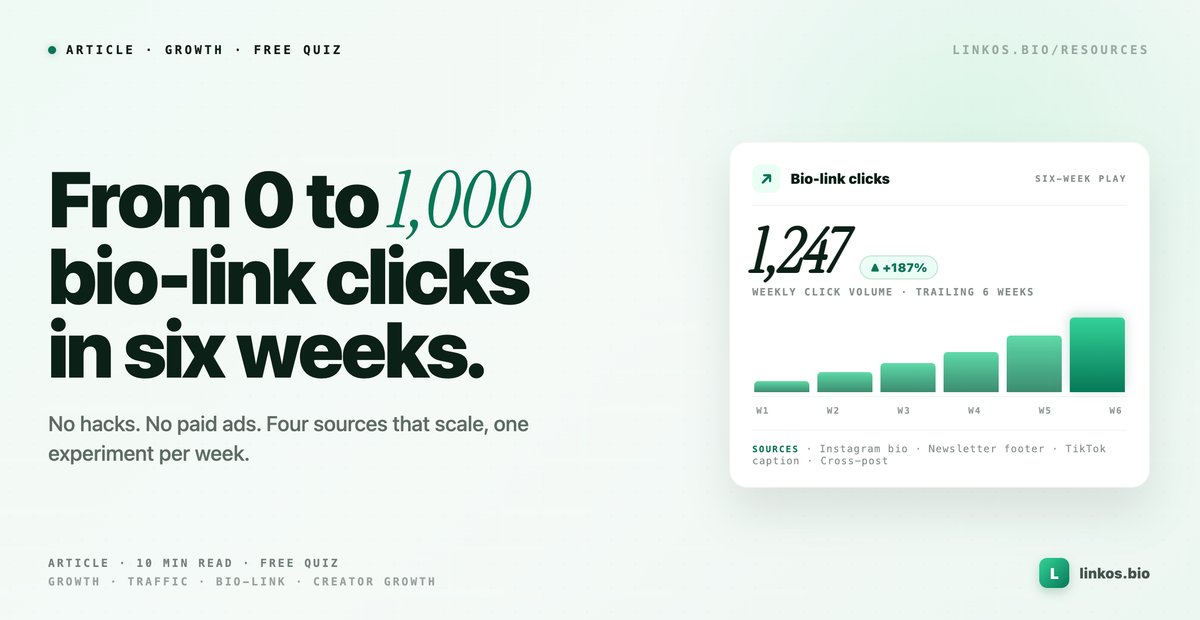
From 0 to 1,000 bio-link clicks
A six-week play for the top of your funnel. No hacks. No paid ads. Just four sources that scale.
A thousand clicks isn't a milestone. It's the smallest volume of traffic where your data starts telling the truth. Below that number, everything you see on your bio page is noise — one viral post, one lucky Story, one week where you happened to catch the algorithm at a good angle. You can't build on that. You can't repeat it. You can barely explain it.
At around a thousand clicks a month, the shape of your funnel becomes visible. Click-through rates settle into believable bands. Conversion percentages stop swinging by ten points every week. The share of visitors who come back a second time — the single most useful metric a creator has — becomes measurable instead of theoretical. That's why the number matters. Not because 1,000 is impressive. Because at 1,000, you can finally see what's working and stop guessing.
The same is true in reverse: creators stuck below 1,000 usually think they have a traffic problem when they actually have a signal problem. They can't tell which post drove which click, so they can't repeat the good ones or drop the bad ones. Getting to 1,000 isn't about reach — it's about earning the right to make evidence-based decisions instead of vibe-based ones.
The four traffic sources that scale
Most creators spread themselves across ten platforms and wonder why nothing moves. The honest math is that four sources do almost all the work, ranked here by effort against leverage.
Instagram bio-link
This is the highest leverage per hour you'll ever get. Every post you make points back here. Every DM you reply to, every comment you answer, every Story you drop — the bio-link is the shared destination of your entire Instagram brain. You don't have to think about it. The platform funnels people toward it structurally.
Cost: minutes per week to keep the top link current. Return: this is usually the largest single source once your account is above a few thousand followers. When it stops working: when your bio-link is stale, or when it points to a homepage instead of a specific offer.
TikTok caption drop-off
The second-best source, and the most under-used. TikTok doesn't want clickable links in captions, but it doesn't punish "full breakdown in bio" either. Drop the phrase in when the content actually earns it — a tutorial with a downloadable, a review with a discount, a rant with a receipt.
Cost: one line per relevant video. Return: less volume than Instagram, but the intent is higher — people who click through from TikTok already wanted the extra thing. When it stops working: when it feels spammy. Every video is too many. Every third is about right.
Newsletter footer
Steady, not spiky. The bio-page URL belongs in your email footer for one reason: subscribers who forgot your name still find their way back. They open the email, scroll to the bottom, click the bio link, and land somewhere they recognize. It's not glamorous. It's a small, reliable trickle that compounds over months.
Cost: ten seconds, once, forever. Return: single-digit percentage of your total clicks, but the highest-converting visitors you'll see. When it stops working: it doesn't, really. Just don't expect it to grow fast.
Cross-posted long-form
Every blog post, YouTube description, and podcast show notes ends with your bio-page URL. This one is slow. Traffic from a YouTube video written today might not peak for eight months. But long-form content is the only source that keeps working after you stop actively feeding it.
Cost: one line at the end of every piece. Return: modest in month one, meaningful by month six. When it stops working: only when you stop making the long-form.
Four sources. That's the whole list. If a fifth source pulls at your attention, notice it, write it down for later, and keep working the four.
The six-week play
Here is the schedule. One thing per week. No parallel experiments, no "while I'm at it," no bundling. The point is to see what moved.
Week 1 — Fix the top link
Baseline your metrics before you change anything. Write down your current CTR, dwell time, and repeat-visitor share. Then rewrite your top link using Write a top link that converts. Don't add anything new. Fix what you have. A bio page with one strong top link outperforms a bio page with eight mediocre ones — and the metric that proves it is CTR on the first slot.
Week 2 — Add the bio-page URL where it belongs
Put your bio-page URL in your Instagram bio, your TikTok bio, and your newsletter footer. That is the entire week. No new content. No new offers. Just make the destination reachable from the three places people already are. If this feels underwhelming, good — most of growth is doing the boring thing you skipped six months ago.
Week 3 — Post three pieces of content that reference the bio page
Not "check my bio." Actual content. "The full toolkit is in my bio." "The template list is in my bio." "The 40-minute breakdown is in my bio." Three posts, three specific mentions, three specific reasons for someone to click. Then check your click-source data. You'll usually see one of the three outperform the others by four or five times. That's your pattern.
Week 4 — Rewrite one Instagram Story CTA to point at the bio page
Pick one Story a day for a week and swap the CTA. If dwell time on the bio page goes up — even by a few seconds on average — you've found a repeatable pattern worth doing weekly. If it doesn't, the CTA copy is the problem, not the channel. See Link-in-bio metrics that actually matter for how to read dwell honestly.
Week 5 — Cross-post your best piece
Take the best-performing piece of content from the last six weeks and post it somewhere new. Threads, LinkedIn, X, a Reddit community that fits. Every cross-post ends with the bio-page URL. You're not trying to go viral on a new platform. You're extending the shelf life of something that already worked.
Week 6 — Review and cut
Open your click-source data. One source moved more than the others. Double down on it for the next six weeks. Kill or defer everything else. This is the part most creators skip, which is why most creators end up doing eight things badly instead of two things well.
What 1,000 clicks actually means for revenue
Do the math before you do the work. A thousand clicks means nothing until you attach a conversion rate and a price. Realistic bands, from cold to warm:
- Cold audience — people who have never heard of you. Around 1% will do the thing you want. So 1,000 clicks equals roughly 10 conversions.
- Warm audience — people who already follow you somewhere. Around 4% convert. 1,000 clicks equals roughly 40 conversions.
- Existing subscribers — people who already opted in to hear from you. Around 10% convert. 1,000 clicks equals roughly 100 conversions.
Now plug in a price. If your product is a €30 template pack and your traffic is warm, 1,000 clicks equals about €1,200 in revenue in that month. If your product is a free newsletter, 1,000 clicks equals about 40 new subscribers, which is a small number that becomes a big one after six months of compounding. If your product is a €99 course and your traffic is a mix of cold and warm, expect somewhere between €500 and €1,500 depending on how well the top link matches the offer.
The point of the math isn't the specific numbers. The point is that "1,000 clicks" only becomes a business decision when you've decided what a click is worth. If your average click is worth €0.50, the six-week play returns €500 a month. If your average click is worth €3, the same play returns €3,000. The traffic work is the same. The value depends on what you're pointing it at.
Where the guided version lives
If you want the guided version of the six-week play — with the actual experiments week by week — the Growth Playbook path walks through it in Sloth+ Academy. It's the path we recommend when creators want to close the gap from 100 clicks a month to 1,000+.
Common growth mistakes
Chasing volume before you've fixed conversion
Five thousand clicks landing on a broken top link is worse than five hundred landing on a good one. The five hundred teach you something. The five thousand burn attention you can't get back. Fix the top link before you turn on any new traffic source, because the traffic source will magnify whatever the top link already does — good or bad. A page that converts at 2% and gets 500 visits beats a page that converts at 0.4% and gets 5,000.
Adding a fifth source before the first four work
Every creator who adds Threads before their Instagram bio-link is finished ends up with two half-working channels instead of one working one. Spread thin usually loses to focused execution, especially in the first six months. The four sources listed above are load-bearing on purpose. If any of them is under-worked, that's the next thing to fix — not a new platform.
Reading week 1 as the answer
A bad first week doesn't mean the play failed. It means the top of your funnel needs another week to warm up. Traffic sources rarely respond instantly, especially cold ones like a newsletter footer or a YouTube description. Trust the six-week window over any single day. The whole point of a longer play is that it survives a slow start — and slow starts are the rule, not the exception.
Pop quiz · 5 questions · ~60 seconds
Do you actually read your bio-link metrics — or just glance at them?
Answer 5 multiple-choice questions. See your tier at the end. Bragging rights optional.
What to do this week
Implement Week 1 of the schedule. Concretely:
- Open your bio page.
- Rewrite the top link using Write a top link that converts.
- Write down your current CTR, dwell, and repeat-visitor share.
- Do not touch anything else for 14 days. Let the data breathe.
That's the whole week. The urge to also change the second link, add a new section, and try a different theme will be strong. Resist it. You're not being lazy — you're keeping the experiment clean enough that next week's data means something.
What comes next
The Growth Playbook path inside Sloth+ walks through the full six-week schedule with the actual weekly experiments, the metrics to log, and the review templates for Week 6. Sloth+ starts at €4.99/mo, and the full path is included. If you want to see how it stacks against the free plan before committing, plans-explained has a side-by-side of what each tier includes.
A thousand clicks a month is a modest target and a useful one. It's small enough to reach without gimmicks, and large enough that the numbers start being real. Get there once, then get there again the month after, and you'll notice the work has changed shape — you're no longer guessing what to do, you're picking between two things you know work.
Sign up to start earning XP for every read.
📗 Free: the Link-in-Bio Starter Kit
The checklist, 6 layout templates, and our 1-page cheat sheet — sent straight to your inbox.
Recommended tool
Turn each topic into a finished post — in seconds.
PostPop writes the copy and designs the carousel in your real colours, fonts and logo. The making step, gone.
- On your brand, automatically
- Six formats · every platform size
- Free to start · no credit card
◆ A product by Linkos